

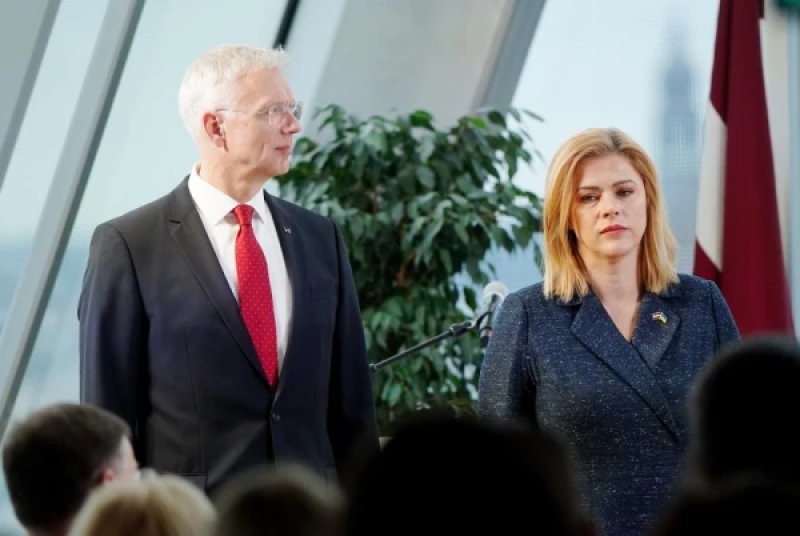
 Foto: BB.LV / Кариньш и Силиня
The politician admitted that he himself supported her appointment as prime minister, but later became disappointed in his decision. Karins spoke about this in the podcast of the portal [tv3.lv](https://tv3.lv/zinas/ekonomika/pikis-un-gevelis/tas-ir-silinas-nopelns-karins-komente-jaunas-vienotibas-slikto-rezultatu-velesanas/) "Piķis un ģēvelis!". ### “I thought she would adapt. I admit, I was wrong” Commenting on the poor result of "New Unity" in the parliamentary elections, Karins directly linked it to the activities of Evika Silina as prime minister. > "I apologize if anyone is offended by this, but I consider it Silina's merit," said the former head of government. At the same time, Karins reminded that he actively supported her candidacy at the time. According to him, when he himself headed the government, Silina proved to be a capable parliamentary secretary. He still considers her a smart and convincing politician. However, the expectations that she would successfully adapt to the position of prime minister, according to Karins, were not met. > "I thought she would adapt to this position. I admit, I was wrong. Now it can be said that we are all paying dearly for this," he said. ### “I no longer know what 'Unity' stands for” One of the main reasons for the party's deteriorating situation, Karins believes, is the loss of clear political priorities. According to him, during his own leadership of the government, he paid special attention to transforming the economy, attracting investments, and supporting enterprises capable of competing in international markets. However, under Silina, the former prime minister believes, economic development ceased to be the central theme of the political agenda of "New Unity". Instead, other issues came to the forefront, and the political identity of the party gradually became less clear to voters. > "If I am asked today what 'Unity' stands for? I no longer know what 'Unity' stands for," Karins admitted. ### Karins acknowledged that his assessment may be subjective The former prime minister did not deny that his attitude towards Silina may be related to his personal political experience. According to Karins, it was she who at one time "pushed him aside" from active politics. Nevertheless, he is convinced that the election results confirmed the concerns he expressed earlier. At the same time, Karins acknowledged that the responsibility for the party's failure cannot be placed solely on one person. ### “New Unity” received only seven seats in the Saeima In the elections on October 3, 2026, "New Unity" received seven parliamentary mandates compared to 26 in the previous parliamentary elections. This is the worst result for the political union in terms of the number of seats in the Saeima. Evika Silina herself previously stated that the responsibility for the unsatisfactory result should be borne by the entire party leadership, as decisions were made collectively. She also acknowledged the need to revise approaches to working with voters. Thus, Karins links the defeat primarily to Silina's leadership and the change in political priorities, while the former prime minister herself speaks of the collective responsibility of the party leadership.
