

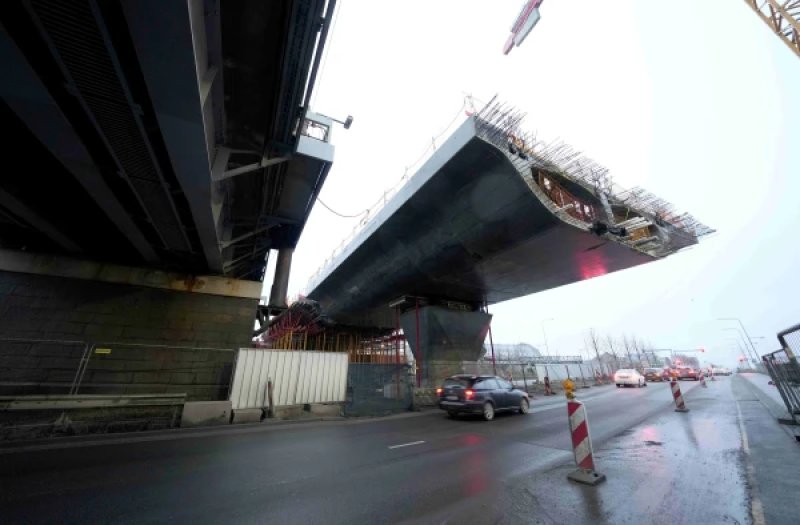
 Foto: BB.LV / Rail Baltica
This was reported by the company Eiropas dzelzceļa līnijas (EDzL), responsible for the implementation of the project in Latvia. From November 9 to 11, representatives of the European Climate, Infrastructure and Environment Executive Agency (CINEA) visited Riga. The purpose of the visit was to check how the funds allocated by the European Union for the construction of the main Rail Baltica route and the railway station at Riga Airport are being used. European specialists also familiarized themselves with the progress of the project in Estonia and Lithuania. ### Construction is proposed to be made cheaper The Latvian side presented possible options for optimizing technical solutions on the main route to European partners. This involves revising certain construction solutions, which will allow reducing the cost of work without abandoning the main goals of the project. At the same time, the functionality of the railway, safety requirements, and compliance with European high-speed rail standards must be maintained. According to EDzL, such optimization will help narrow the gap between already allocated funding and actual construction costs. In addition, revising technical solutions together with contractors should accelerate the work and reduce the risk of delays. Board member Davis Blaus emphasized that Rail Baltica remains one of the most important European transport projects. According to him, the analysis conducted showed that construction can be organized more economically without sacrificing quality, safety, and functionality of the infrastructure. ### Everything depends on the government's decision The implementation of new technical solutions could begin as early as the end of 2026. However, for this to happen, the government of Latvia and the Ministry of Transport must confirm the allocation of additional funding from the state budget. This will allow the continuation of construction and the utilization of European funds within the extended deadlines of the Connecting Europe Facility (CEF) agreements. A backup option is also provided: if the optimization of certain sections takes longer, builders will be able to continue work according to previously approved technical projects. Thus, the revision of solutions should not lead to a halt in construction. ### Latvia may lose more than 100 million euros The situation is complicated by the issue of using already provided European funding. Earlier, the TV3 program "Nekā personīga" reported that representatives of European structures intend to find out why Latvia has not yet utilized part of the available funds for Rail Baltica. According to journalists, the country may lose more than 100 million euros, as CINEA has the right to consider reallocating unused money to other projects. However, the Ministry of Transport emphasizes that there are no final decisions yet. During the November visit of European representatives, changes to the financing agreements were not approved. A decision will be made after assessing the results of the meetings and further studying the information presented. This process is expected to be completed by the end of the year. The willingness of the Latvian government to allocate budget funds to cover the financial deficit will also play an important role. ### European funding depends on real progress Marco Kivila, chairman of the joint venture of the Baltic countries RB Rail, noted that Rail Baltica is a single international project. The full effect of the new railway will only be achieved after connecting all three Baltic countries to the European railway network. Therefore, it is especially important that construction progresses simultaneously in Latvia, Lithuania, and Estonia. For Latvia, it is now crucial to demonstrate concrete results on the main route. The ability to carry out planned work and effectively utilize already allocated EU funds will be one of the key conditions for both maintaining current funding and obtaining further European support. During the visit, CINEA representatives inspected the southern section of the Latvian route, where earthworks, construction of access roads, and preparations for the next stages are already underway, as well as the construction site of the Rail Baltica station at Riga Airport. ### How much will Rail Baltica ultimately cost? According to the latest estimates, the cost of the first phase of the project in all three Baltic countries may reach 14.3 billion euros. Of this amount, Latvia accounts for about 5.5 billion euros. With indexing, expenses may increase to six billion. The total cost of Rail Baltica, according to the cost-benefit analysis, may amount to 23.8 billion euros. For comparison, in 2017, the implementation of the entire project was estimated at 5.8 billion euros. In the first phase, Latvia plans to build the main railway line from the border with Lithuania to the border with Estonia, as well as complete work at the Riga Airport station and in the southern part of the Riga Central Station. At the same time, the so-called Riga loop is not included in the first phase. The Rail Baltica project involves the construction of a railway of European gauge of 1435 millimeters, which will connect Tallinn with the borders of Lithuania and Poland, ensuring further communication with other European countries. The total length of the new line in the Baltic countries will be about 870 kilometers, and the maximum speed of passenger trains should reach 240 kilometers per hour.
