

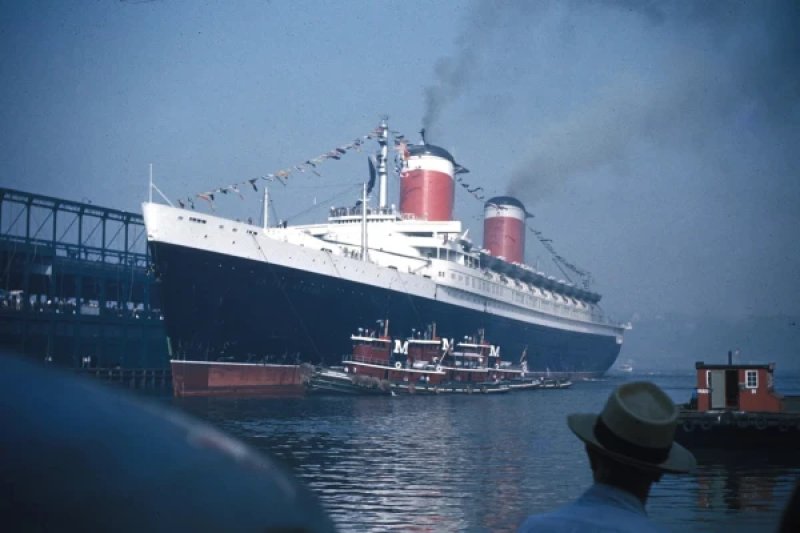
 Foto: BB.LV / Лайнер SS United States.
The historic liner SS United States finally sank on the evening of November 11 in the Gulf of Mexico, near the resort town of Destin. The operation lasted several hours and was broadcast live. According to Reuters, the ship, which is about 302 meters long, was specially prepared for sinking to turn it into the largest artificial reef in the world. ### How the legendary liner was sunk Preparation took more than a year. Specialists removed remnants of fuel, electrical wiring, glass, and other materials that could pollute the environment or pose a danger to divers. Special holes were made in the hull and decks to allow water to fill the interior spaces evenly. No explosives were used in the process. Inside the ship, passages were also created through which marine inhabitants could move freely. As a result, the liner sank to a depth of about 55 meters. Its upper decks are located approximately 15–17 meters below the water's surface. ### A ship that was ahead of its time SS United States was launched in 1951, and in 1952 it made its first transatlantic voyage, setting a speed record among passenger liners. The ship was considered one of the most outstanding achievements of American shipbuilding. On board, it hosted famous politicians, members of royal families, and show business stars. However, with the development of passenger aviation, ocean travel gradually lost popularity. The liner was retired in 1969. The following decades were spent docked in Philadelphia. Attempts to restore the vessel and turn it into a museum or hotel were unsuccessful. ### Instead of scrap metal — an underwater world In 2024, the authorities of Okaloosa County in Florida acquired the liner to save it from final disposal. The project, costing about $13 million, aims to create a unique underwater object that will eventually become home to fish, corals, and other marine organisms. Researchers from the Woods Hole Oceanographic Institution intend to observe the formation of a new ecosystem around the ship. The organizers hope that the sunken giant will attract divers from around the world and become one of Florida's main underwater attractions. Thus ended the story of one of the fastest passenger ships of the 20th century — and a new one began, already underwater.
