

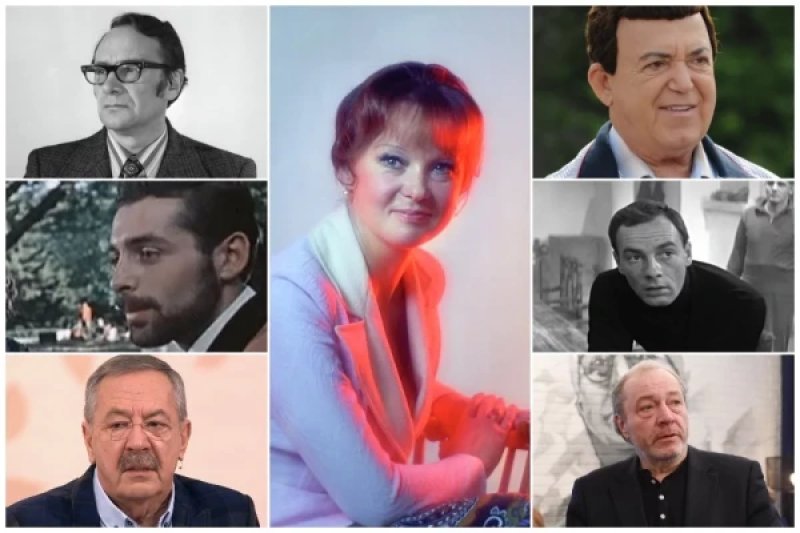
 Foto: BB.LV / Людмила Гурченко и ее мужья
Throughout her life, the legendary actress sought a man who would be a reliable support and a creative like-minded person for her, but on the path to family happiness, she had to make a new choice more than once. Let’s recall who the main men in the fate of the great artist were and why each of these unions left its mark on her biography. **Vasily Ordynsky (1953–1955)** Gurchenko's first husband was film director, screenwriter, and front-line soldier Vasily Ordynsky — the future author of the famous films "First Love" and "Walking Through the Torments," a People's Artist of the RSFSR. They met at VGIK: 18-year-old Lyudmila had just enrolled in the acting faculty, while 30-year-old Ordynsky was already finishing his directing workshop under Sergey Gerasimov and Tamara Makarova. Ordynsky went to the front in August 1941 — after graduating from the infantry school in Sterlitamak, from June 1942 he commanded a fire platoon of a mortar company, fought on the Voronezh and 1st Belarusian fronts, was seriously wounded, and after treatment commanded a platoon of cadets before returning to the front, finishing the war in Germany with the rank of senior lieutenant. In the 1960s–1980s, Ordynsky headed the artistic council at the Higher Courses for Scriptwriters and Directors, teaching courses in "Film Directing" and "Editing." The marriage of Gurchenko and Ordynsky lasted less than two years: according to one version, it was destroyed by unfulfilled creative hopes — Ordynsky did not cast his wife in his diploma film "A Man Was Born," believing that she lacked both talent and dramatic experience. The role eventually went to Olga Bgan, whom Gurchenko later dubbed. The actress herself admitted that she married too early and was not yet ready for family responsibilities — ahead of her lay all-Union success and recognition in "Carnival Night." **Boris Andronikashvili (1958–1960)** The second husband of the star was screenwriter, historian, and actor Boris Andronikashvili — the son of the writer Boris Pilnyak, who was shot in 1938, and actress Kira Andronikashvili, a Georgian princess. After his father's arrest, his mother managed to send her son to his grandmother in Georgia, who adopted him. He had a brilliant biography: Andronikashvili studied at VGIK in the screenwriting and film studies department, graduating in 1959, possessed an extraordinary aristocratic appearance, and was considered one of the most promising students, although he never made a successful career. In 1959, the only daughter of Gurchenko, Maria, was born from this marriage, who later worked as a nurse. By that time, the actress was already famous after "Carnival Night," but was going through a difficult period of ostracism from film officials, so the girl was mainly raised by her grandmother in Kharkiv. Gurchenko herself called Andronikashvili one of her strongest attachments, but the beautiful couple parted due to her husband's constant affairs on the side. After the divorce, Boris was in a civil marriage with Nonna Mordyukova for five years — many considered her the complete opposite of the graceful Lyudmila Gurchenko. **Alexander Fadeev Jr. (1962–1964)** The third husband of the actress was actor Alexander Fadeev Jr. from the Theatre of the Soviet Army — the adopted son of the classic of Soviet literature Alexander Fadeev and the star of the Moscow Art Theatre Angelina Stepanova. Gurchenko later considered this union the biggest mistake of her life. According to contemporaries, the talented but hedonistic heir to a famous name chronically abused alcohol and constantly cheated on his wife. He easily entered the Moscow Art Theatre School and got into the Theatre of the Soviet Army, but was soon fired for disciplinary violations: he missed rehearsals, came with unlearned lines, and could disappear right in the middle of a rehearsal. The last straw was a scandal involving jealousy, during which a drunken Fadeev fired a hunting rifle — the bullet missed, and a huge hole appeared in the wall — after this incident, Gurchenko filed for divorce. After the divorce from Gurchenko, he married twice more, including to Joseph Stalin's granddaughter Nadezhda. Fadeev Jr. died in 1993 in loneliness and poverty. **Joseph Kobzon (1967–1970)** Gurchenko's fourth marriage to pop singer Joseph Kobzon was the loudest and most public. The two stars of the Soviet stage got married in Kuibyshev, each already having an unsuccessful experience behind them: for Kobzon, it was his second marriage, and for Gurchenko, it was her fourth. The reason for the hasty registration was an incident that occurred during the singer's tour: Gurchenko flew to Kobzon to surprise him, but they were not allowed to share a room in the hotel, as only spouses could stay there according to the rules. Lyudmila had a fit, and Joseph arranged for them to get married right in Kuibyshev. Later, Gurchenko recalled that the relationship between two bright, talented people with complex characters resembled a battlefield with mutual jealousy and domestic scandals. At the same time, Kobzon was warm towards the actress's daughter Maria and took care of her upbringing while Gurchenko was away filming. The union finally collapsed after the singer spent New Year's Eve at a suburban dacha with Gurchenko's close friend — actress Tatyana Bestayeva. An angry Gurchenko sent him a telegram: "A hunchback is corrected by the grave," to which Kobzon replied: "I remain as I was. Hunchbacked." After the divorce, the former spouses avoided communication for decades, and even during random meetings at concerts, they pretended not to know each other. Once, in a tour bus, Gurchenko even hissed at him: "I hate you," and he calmly replied: "Then you love me." **Konstantin Kupeevays (1973–1991)** With pianist, composer, and arranger Konstantin Kupeevays, Gurchenko lived for 18 years without an official stamp in her passport. They met in the summer of 1973 during rehearsals for the musical program "The Comrade Cinema Sings," when the actress was struggling with the recent death of her beloved father, Mark Gavrilovich. 23-year-old Kupeevays was 15 years younger than his chosen one — a conservatory graduate, he moved to Moscow from Kharkiv and worked as a pianist in a pop orchestra. He inherited his passion for music from his father — pianist Tovyash Kupeevays, who hid from the Nazis, and his skill helped him survive, while almost all of his relatives perished in Treblinka. Kupeevays's mother was also a pianist. For Gurchenko, he even left his own career: he became her accompanist, concert director, administrator, and main support during the actress's loud return to the big screen in the 1970s and 1980s. However, over time, the musician grew tired of remaining in the shadow of his star wife, and in the early 1990s, their long union fell apart. The reason for the separation was Gurchenko's departure to a new partner, although Kupeevays noted that in the last years, they had become strangers to each other. Later, he wrote a book "Golden Years" about his life with Gurchenko. **Sergey Senin (1993–2011)** The last companion of the actress's life was film producer Sergey Senin, who was 26 years younger than her. They met in the early 1990s during the filming of the movie "SexTale" based on a story by Vladimir Nabokov, where Senin was the producer, and Gurchenko played the lead role. This marriage turned out to be the calmest and most harmonious in the actress's biography and lasted almost two decades. Senin helped Gurchenko realize her late creative ideas — including her directorial debut "Colorful Twilight," which was released in 2009. He protected his wife's peace and remained by her side until her death on March 30, 2011. After the actress's passing, Senin opened the Lyudmila Gurchenko Museum-Studio in Moscow in the apartment where she lived her last years in 2016. To preserve the home environment, he gave the dacha and a payment to the actress's daughter's family and is still paying off the loan for it, while renting his own accommodation. To this day, Senin continues to work with Gurchenko's legacy, transcribing her diaries from the 1980s, part of which the actress planned to publish in her third book. According to him, the image on the screen often did not match the real Gurchenko: "In life, she was an absolutely different person, often a silent introvert, and did not trust the phrase 'I love you,' valuing only actions," Senin later admitted.
