

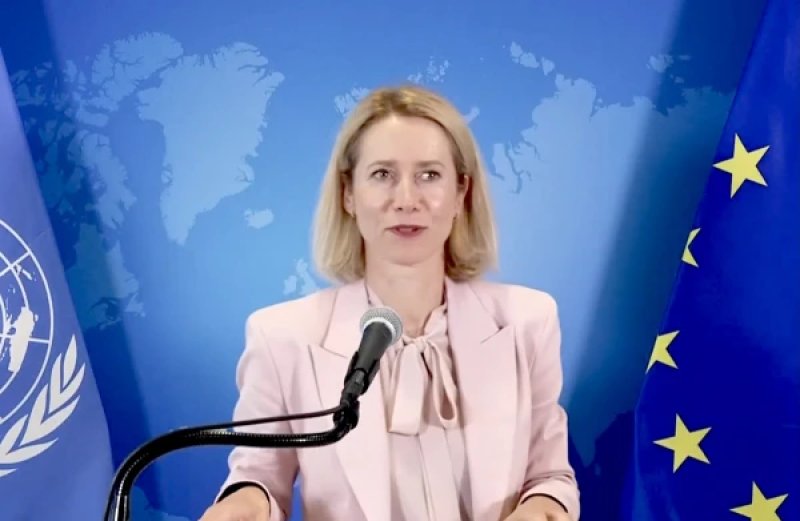
 Foto: BB.LV / Каллас
Russia has made the issue of security architecture one of its main priorities, which has provoked objections from Europeans. In their opinion, this is merely a ploy aimed at distracting attention from the war in Ukraine and realizing Moscow's long-standing ambitions to re-establish itself as a great power. "Ultimately, it is we, the Europeans, who will determine and decide what our security will look like in the future. I have no doubt about that," French President Emmanuel Macron said on Thursday, opening a summit of leaders in Dublin, Ireland. "Europe must first and foremost clearly understand what it wants. At this point, Europe's position on supporting Ukraine is completely clear. Now we need to formulate a concrete vision of our peace plan and future security architecture." Echoing Macron, German Chancellor Friedrich Merz called on Russia for direct dialogue with European representatives — a step that Moscow has yet to agree to. The latest round of negotiations in Abu Dhabi included high-ranking representatives from France, Germany, the United Kingdom, Italy, the European Commission, the European Council, and NATO. However, none of them made contact with the Russian delegation. "Ukraine must sit at the negotiating table. Europeans must sit at the negotiating table. Americans and, of course, Russia — they all must sit at the negotiating table," Merz stated. "It is important for Russia to sit at the negotiating table and be ready for dialogue." EU High Representative Kaja Kallas emphasized the importance of adhering to a "sequence" in the diplomatic process: first — a ceasefire in Ukraine, then — a peaceful settlement, and at the final stage — discussions on the architecture of European security. "We already have a European security architecture," she noted, referring to the Helsinki Accords of 1975, the Paris Charter of 1990, and the Budapest Memorandum of 1994. "The problem is that Russia does not comply with these agreements." Estonian Prime Minister Kaja Kallas stated that resuming discussions on security architecture is a "trap" set by Moscow to achieve the "impossible," including rolling NATO back to its previous borders — a goal that Russian President Vladimir Putin has proclaimed as one of his strategic objectives. In the weeks leading up to the full-scale invasion of Ukraine, the Kremlin issued NATO an ultimatum to stop its eastward expansion and withdraw troops from the territories of countries that joined the alliance after 1997. These demands were completely rejected. A few months later, two historically neutral countries, Finland and Sweden, applied for NATO membership. Lithuanian President Gitanas Nausėda insisted that negotiations must take place on "fair terms" and with the presence of Europeans. "Discussions behind the backs of Ukrainians should be avoided, and, of course, discussions on the future architecture of European security should involve the European Union," Nausėda told reporters. This collective reaction followed the day after Vladimir Medinsky, who heads the Russian delegation at the peace talks, reaffirmed Moscow's desire to go beyond the "Ukrainian issue" and discuss security architecture on a broader scale. "The whole organism is sick, and Ukraine is just the place where the abscess has burst. Therefore, the whole organism needs to be treated. A single band-aid won't suffice here," Medinsky stated in Abu Dhabi, using rather crude imagery. However, Medinsky refused to engage in dialogue with Europeans, citing their military and financial support for Ukraine. (However, this does not mean a complete ban on contacts: last month, Putin had a 90-minute phone conversation with the leaders of Finland and Norway.) The emphasis on security architecture was heightened by U.S. President Donald Trump and his special envoy Jared Kushner, who recently shocked Europeans with a lengthy social media post outlining the principles of a post-war model. While in Abu Dhabi, Kushner asked the Russians to prepare "proposals" that could be discussed in a face-to-face meeting with Europeans. Kushner then flew to Moscow to secure Putin's "blessing" for shifting the negotiations to a multilateral format. Ukrainian President Volodymyr Zelensky described this approach as "a bit strange" and advised Europeans to "take it very seriously."
