

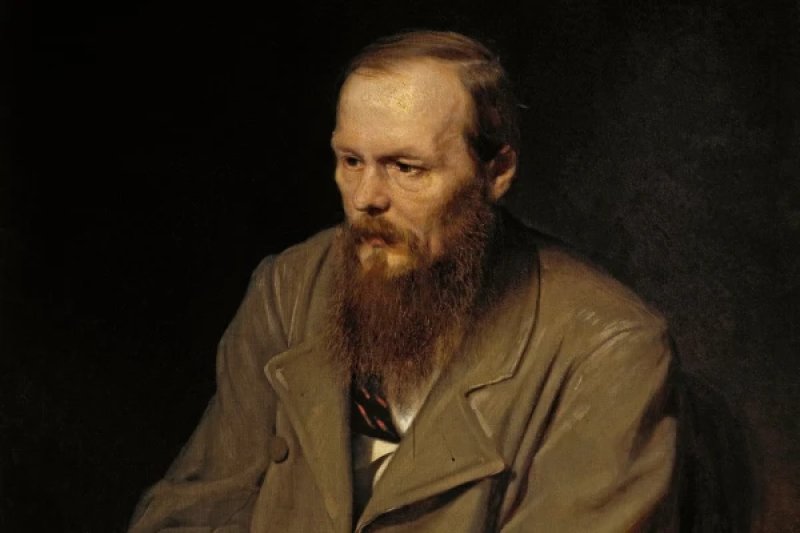
 Foto: BB.LV / Федор Михайлович Достоевский
New terms were picked up by other authors — Ivan Turgenev, Mikhail Saltykov-Shchedrin, and Leo Tolstoy; they became popular among the people, and some of them entered the core lexical fund of the Russian language. On the writer's birthday, we gathered words that we still use today, as well as words of the author that turned out to be too original for everyday speech. **Stushovatsya** The history of the creation of the word "stushovatsya" is a unique case where a strictly professional, drafting term transformed into a profound psychological concept thanks to the linguistic intuition of one person. Fyodor Mikhailovich Dostoevsky was so proud of his invention that many years later, in 1877, he dedicated a separate chapter to it in his "Writer's Diary." "...In all of Russia, there is only one person who knows the exact origin of this word, the time of its invention and appearance in literature. This person is me, because I introduced and used this word in literature for the first time — me. This word appeared in print for the first time on January 1, 1846, in 'Notes of the Fatherland,' in my story 'The Double, the Adventures of Mr. Goladykin.'" The word was born between 1838 and 1841 when the young Dostoevsky was studying at the Main Engineering School in St. Petersburg. Students had to make a huge number of drawings of fortifications and building facades. To give the drawing volume, ink was used. There was a strict technical term — "to shade," meaning to apply ink for shadows, creating a smooth transition from dark to light. Among Dostoevsky's classmates, the slang word "stushovatsya" was born. In student slang, it meant to make this transition with ink so inconspicuous that the black shadow faded away, completely dissolving and disappearing on white paper. Soon, students began to jokingly apply it to people: if someone quietly left the room or tried to become "invisible" before a strict teacher, it was said that he "stushovatsya." The word would have remained forgotten student slang of the Engineering School if not for Dostoevsky's literary debut. The writer was looking for a concise word capable of conveying the extreme degree of embarrassment, fear, and the desire of the main character, Yakov Goladykin, to literally dissolve into the air, to disappear from shame. Dostoevsky took the word familiar from his youth and introduced it into print for the first time. "...Mr. Goladykin... would like now... to fall through the ground or to stushovatsya along with his boots..." **Limonnichat and Apelsinnichat** The word "limonnichat" owes its origin to the Omsk penal servitude, where Dostoevsky, sentenced in the Petrashevsky case, spent four years. In exile, the writer communicated a lot with other convicts and recorded their expressions in his famous diary — "Siberian Notebook." "What are you limonnichat with me? What are you apelsinnichat with me?" is noted in entry number 60. Apparently, Fyodor Mikhailovich heard the word "limonnichat" from one of the prisoners. It probably appealed to him so much that he introduced it into everyday use. Fyodor Mikhailovich used the verbs in the story "The Village of Stepanchikovo and Its Inhabitants," placing them in the mouth of the landowner Bakhcheev, meaning "to be charming, to be coy." "And what does a serf need to know French for, I ask you? What does our brother need to know French for? To limonnichat with the ladies in mazurka, to apelsinnichat with other men's wives? Debauchery — nothing more." Dostoevsky also used the words "limonnichat" and "apelsinnichat" in the legendary "Crime and Punishment." "She comes to me in the morning, — said the elder to the younger, — very early, all dressed up. 'And what are you limonnichat before me, what are you apelsinnichat before me?' — 'I want, says she, Tit Vasilyich, from now on, to be entirely at your disposal.' So that's how it is! And how dressed up she is: a magazine, just a magazine!" — gossiped among themselves the workers who were pasting wallpaper in the apartment of the moneylender. **Beloruchnichat** The word "beloruchnichat" appears in several of Dostoevsky's works and journalistic articles. The verb invented by the writer meant "to avoid physical labor, to behave delicately, like a white-handed person." The word, for example, appears in the story "Notes from the House of the Dead," when the main character reflects on what kind of behavior was expected from him, as a former nobleman, by other convicts in the penal colony. "However, according to their concepts (and I learned this later for sure), I still had to observe and respect my noble origin before them, that is to pamper myself, to break down, to disdain them, to snort at every step, to beloruchnichat. That is how they understood what a nobleman is." In the journalistic article "Slavophiles, Montenegrins, and Westernizers" from 1862, Dostoevsky discusses the importance of small deeds for society and criticizes those who only expect immediate large success: "And if we all beloruchnichat, waiting directly for millions from the sky, so that it would not be shameful for us, such important people, to engage in penny matters, — then we will never see a ruble with this calculation." **Words That Remained on the Pages** Some words invented by Dostoevsky, however, did not become part of everyday speech but are interesting as experiments with the Russian language. Vsemstvo — a concept from the story "Notes from Underground," meaning a faceless mass of people, "all of us," common opinion. Slovoyers — a concept introduced by the writer in "The Brothers Karamazov" to describe the habit of adding the respectful particle "-s" to words — a shortening of "sir." Shlepokhvostnitsa — a synonym for the word "vertikhvostka," used in the novel "Crime and Punishment." Tuponravstvenny — a person with limited, dull moral principles, found in the essays "Winter Notes on Summer Impressions." Sramec — a shameless person. The word appeared in the novel "Crime and Punishment." Dostoevsky's linguistic experiments are the best proof that the Russian language is plastic, flexible, and capable of absorbing any meanings: from strict drafting engineering to coarse penal folklore.
