

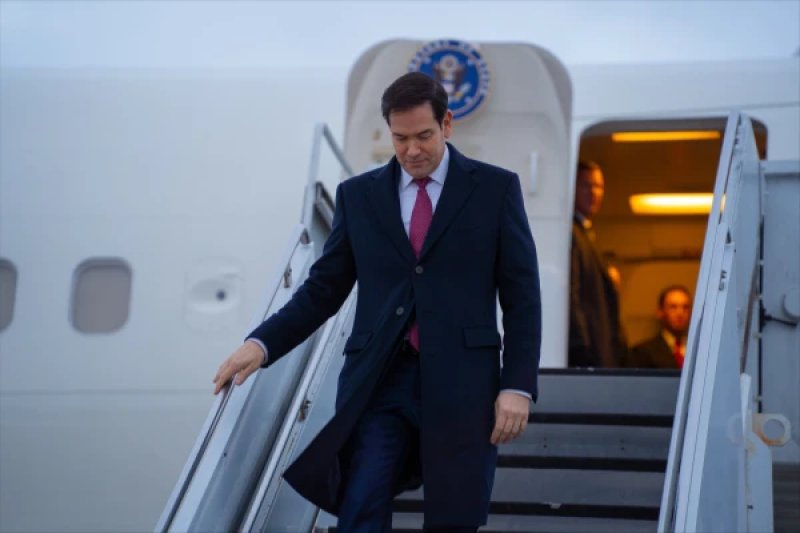
 Foto: BB.LV / Марко Рубио
The United States has faced an unusual series of technical failures that disrupted the operations of airlines, banks, major technology platforms, and government institutions over the course of several days. The scale and frequency of the incidents have raised concerns that American infrastructure may have become a target of a coordinated cyberattack. However, U.S. authorities state that there is no evidence to support this. According to the LETA agency, citing DPA, U.S. Secretary of State Marco Rubio spoke to reporters in the Philippines on Wednesday, November 18, and assured that the available data does not indicate a connection between the failures that occurred. "We are not under systematic attack," Rubio emphasized. According to him, U.S. authorities have no evidence that foreign states, cybercriminals, or other malicious actors are behind the incidents. ### **A major failure halted air traffic nationwide** One of the most serious incidents was the failure on November 13 in the system of the Federal Aviation Administration (FAA). Due to a malfunction of communication equipment, authorities temporarily banned aircraft departures across the country. The restrictions lasted several hours, causing mass delays and cancellations of flights. According to the FAA, on November 13 alone, airlines canceled about 12,500 flights, including more than 9,000 flights from major carriers. The preliminary cause of the air traffic halt was identified as technical problems with the telecommunications infrastructure. U.S. Transportation Secretary Sean Duffy previously pointed out the outdated equipment used by American air traffic control services and the need for its modernization. ### **Issues arose with Microsoft, banks, and United Airlines** The failures were not limited to the aviation sector. Last week, global technical problems affected Microsoft services, including Outlook and Teams. Users and organizations in various countries experienced disruptions in email and other digital tools. The company explained the incident as a technical malfunction and stated that no signs of a cyberattack were detected. On Monday, November 16, United Airlines reported its own technical problems. The malfunctions led to delays of about 150 flights. On the same day, disruptions occurred in the banking services of several major financial institutions in the U.S., including JPMorgan Chase, Bank of America, and U.S. Bank. Users reported difficulties accessing online banking and performing certain transactions. ### **The failure even affected the National Security Agency** On Tuesday, November 17, technical problems were reported in the internal computer network of the National Security Agency (NSA) of the United States. This network is used by agency employees to exchange official, including classified, information. According to American media reports, the system was temporarily unavailable. The NSA explained the incident as maintenance work and emphasized that the agency's core capabilities for ensuring national security were maintained. Thus, within just a few days, the failures affected several critical sectors for the country — air transport, financial services, digital communications, and government information systems. ### **Rubio: no evidence of a coordinated attack** Commenting on the series of incidents, Marco Rubio acknowledged that such events could cause concern among citizens. However, he stated that investigations have not revealed evidence that the failures were part of a unified operation. "We have no evidence or basis to believe that any of these individual incidents are related to malicious actions, cyber hackers, criminals, another state, or any hostile forces," the Secretary of State stated. He emphasized that Microsoft's problems are not related to the FAA incident, and the failures in the aviation system are not connected to the issues in the banks. According to Rubio, each incident has its own causes. At the same time, U.S. authorities continue to monitor the situation and promise to inform the public if evidence of a common threat emerges. ### **The cause may be outdated infrastructure** Representatives of the U.S. administration point out that many government computer systems need modernization. At the same time, updating complex software and maintaining equipment can itself cause temporary disruptions in service operations. The Director of National Intelligence also stated that the available information does not indicate a coordinated cyberattack. However, the series of incidents has already sparked a discussion about the reliability of American digital infrastructure. Democratic Senator Mark Warner, who serves as the Vice Chairman of the Senate Intelligence Committee, noted that he does not yet see signs of foreign interference. At the same time, he pointed out the increasing load on technological systems, including the need to identify and eliminate vulnerabilities more quickly. According to Warner, the development of artificial intelligence accelerates the detection of security flaws, forcing organizations to conduct updates in tighter timeframes. U.S. authorities currently consider the incidents to be unrelated. However, their consequences have once again raised the question of how resilient the country's critical systems are to technical failures.
