

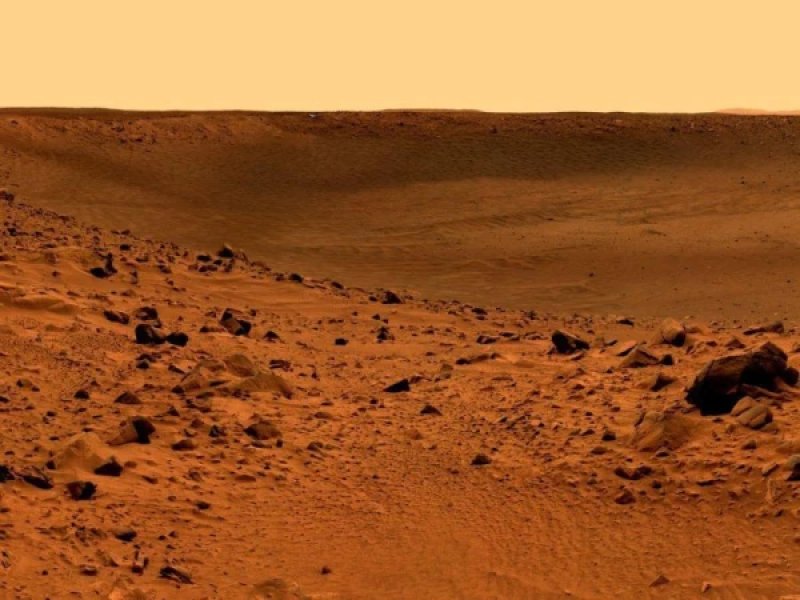
 Foto: BB.LV / Марс
### **Unusual formations discovered near a giant volcano** A study published in the scientific journal [Earth and Planetary Science Letters](https://www.sciencedirect.com/science/article/pii/S0012821X26006230?via%3Dihub) focuses on the area of the Alba Mons volcano in the northern hemisphere of Mars. Scientists examined 738 impact craters and found unusual lobate formations with sharply cliffed edges inside some of them. A total of 29 such structures were identified. The uniqueness of the discovery lies in their shape. Unlike previously known Martian glacial formations, these structures end with high and steep ledges. In some cases, the slopes extend up to three kilometers, and the height of the cliffs reaches 209 meters. According to the researchers, significant masses of ancient ice may be hidden beneath the outer layer of rocks, dust, and other debris. ### **How did scientists find glaciers that cannot be seen directly?** The study utilized images obtained from two spacecraft: the American Mars Reconnaissance Orbiter and the European ExoMars Trace Gas Orbiter. Based on pairs of satellite images, specialists constructed three-dimensional models of the surface, allowing for a detailed study of the shape of the craters and the formations located within them.  The researchers then applied computer modeling to determine how the unusual structures could have formed. They also compared the Martian formations with glaciers in Iceland, including those covered with debris and having steep frontal slopes. > "Such morphology has not been previously described for Martian glaciers covered with debris; however, it resembles the steep frontal parts of some debris-covered glaciers and rock glaciers on Earth," the authors of the study noted. The similarity to Earth’s glaciers became one of the arguments in favor of the glacial origin of the discovered structures. However, the presence of ice directly within all 29 formations remains a scientific hypothesis based on terrain analysis and modeling results. ### **Why has ancient ice not disappeared yet?** Today, Mars is a cold planet with an extremely thin atmosphere. Liquid water cannot be maintained on its surface for extended periods under normal conditions. However, ice exists on Mars, not only in polar regions. Scientists suggest that significant reserves are located beneath the surface, where they are protected from environmental influences. Such a mechanism could have ensured the preservation of glaciers near Alba Mons. According to the model proposed by the researchers, the ice masses formed during a relatively recent geological cold period when the tilt of Mars' rotation axis was significantly greater than it is today. Changes in the tilt of the axis affected the planet's climate, the distribution of solar heat, and the movement of water ice between different regions. Particularly favorable conditions for ice preservation arose on the slopes of craters facing the pole. Over time, the glaciers became covered with a layer of rocks and dust. This natural protective cover could have slowed the loss of ice and allowed it to remain until today. ### **Rocks on the slopes reveal the history of the glaciers** Researchers discovered another interesting feature of the unusual formations. Some slopes show traces of rocks falling from the edges of the craters, their movement downward, and subsequent accumulation at the foot of the cliffs. Such details help understand how the surface of the glaciers changed and what role debris materials played in their preservation. Scientists believe that the interaction of ice with rocks and dust is crucial for the formation of such structures. Moreover, the appearance of glaciers depends not only on the climate but also on the characteristics of the local terrain. This means that even within a single region of Mars, ice could be preserved in completely different ways—depending on the slope's location, steepness, and thickness of the protective cover. ### **Why is the discovery important for future Mars missions?** One of the most interesting prospects of the research is related to the potential use of Martian ice by future astronauts. Water is essential for human survival on another planet. It can be used for drinking, supporting life support systems, and, after appropriate processing, for obtaining rocket fuel components. Transporting large volumes of water from Earth is extremely difficult and costly. Therefore, finding accessible local supplies is considered one of the important tasks in preparing for crewed expeditions. The structures discovered near Alba Mons may indicate areas where significant masses of ice have been preserved relatively close to the surface. However, before considering them as a potential water source, it is necessary to confirm the presence of ice, determine its quantity, and find out how thick the layer of rocks covering it is. Thus, the discovery does not yet mean that scientists have found a ready-made site for water extraction, but it helps identify promising directions for further research. ### **What can Mars tell us about its glacial past?** The scientific significance of the discovery is not limited to future space expeditions. Researchers hope that studying the unusual glaciers will provide better insights into when conditions for accumulating large masses of ice last existed in the Alba Mons region. This is particularly important for reconstructing Mars' climatic history during the late Amazonian period—one of the most recent stages of the planet's geological history. Unlike Earth, where glacial periods are closely linked to changes in climate and orbital parameters, on Mars, fluctuations in the tilt of the rotation axis played a particularly significant role. They could substantially alter the distribution of ice across the planet's surface. The next stages of the scientists' work may involve obtaining more detailed images of the discovered structures, searching for similar formations in other regions of Mars, and further studying Earth’s glaciers, primarily in Iceland. If the glacial origin of the 29 structures is confirmed, they will serve as further evidence that the modern dry and cold Mars has preserved traces of entirely different climatic eras beneath its surface.
