

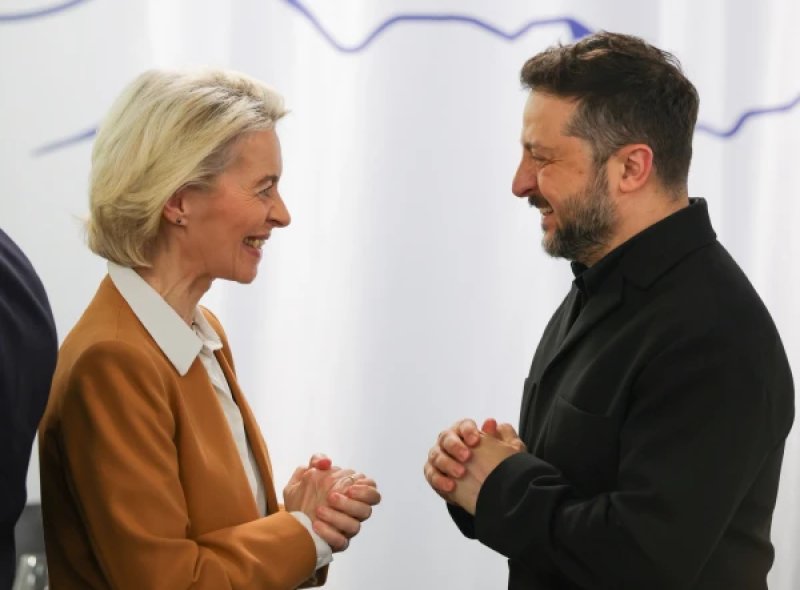
 Foto: BB.LV / Урсула и Зеленский
The European Commission has proposed to grant Ukraine an additional support loan of €45 billion, secured by joint debt, as the war-torn country struggles to keep its economy afloat amid ongoing Russian airstrikes. This loan, presented on Wednesday by European Commission President Ursula von der Leyen, includes €20 billion for financial aid and €25 billion for the purchase of weapons such as drones, missiles, and critically needed air defense interceptors. The funds will be disbursed gradually over the course of 2027 and will complement the existing €90 billion loan that leaders agreed upon last December. "We are sending a clear signal to Russia: we want peace," von der Leyen said. "Five years into this aggressive war, Europe remains united. We are still just as determined to support Ukraine, both during the war and in peacetime." Von der Leyen stated that she is "very confident" that all 27 member states will support this proposal amid ongoing peace negotiations. However, four of them—Slovakia, the Czech Republic, Hungary, and Bulgaria—have already made it clear that they will not participate in the financing. Tense negotiations last year concluded with Bratislava, Prague, and Budapest being granted the option not to participate, and they are now keen to maintain that option. German Chancellor Friedrich Merz responded harshly, threatening to veto the next EU budget, including the much-desired cohesion policy funds, if new aid to Ukraine is not agreed upon by all 27 countries. Slovak Prime Minister Robert Fico called it "blackmail." Von der Leyen supported Merz and emphasized that the loan is divided into two components, civilian and military, to alleviate the concerns of those opposed to arms supplies. EU leaders will discuss this proposal for the first time next week when they gather in Brussels. The agenda will also include the budget, creating a politically explosive combination. The cost of borrowing will be at the center of the discussion. Although the European Commission still enjoys the highest credit rating as a debt issuer, accessing the markets to raise €45 billion will not come cheap. This year, interest rates have surged amid high energy prices, geopolitical instability, investor nervousness, and an expensive race in artificial intelligence. This means that the bloc will have to pay billions of euros annually in interest to maintain support. Nevertheless, the prevailing view is that the cost of a Ukrainian state collapse would outweigh any financial expenses. As with previous programs, the repayment of the principal will be tied to Ukraine receiving reparations for the war. If Moscow is expected to refuse to pay compensation, Brussels reserves the right to use frozen Russian assets worth €210 billion. Ukraine is not expected to repay the debt from its own resources in any case. Von der Leyen stated that the proposal includes "the option of explicitly using frozen Russian cash balances to repay the support loan." "I think this is an additional point that shows we are meeting the needs." Standing next to her, Commissioner for Economy Valdis Dombrovskis stated that the EU budget draft, which is still under discussion, will need to be revised to determine whether the annual interest will be paid as part of future aid to Ukraine or separately from it. The €45 billion announced on Wednesday will be added to the €90 billion support loan. This previous loan, which is still being repaid, was designed under the assumption that Russia's war would end sometime in 2026. In reality, the opposite has occurred: Moscow has intensified its strikes, aiming to make the Ukrainian winter unbearable and destroy the levers of the local economy. The relentless shelling has disrupted business activity, complicated trade, and caused widespread power outages, reducing Ukraine's ability to collect revenue and maintain public services. As a result, the country has become even more dependent on external assistance. The destruction has led to a projected deficit of €70 billion in Ukraine's 2027 budget. The bloc's new €45 billion loan is intended to cover two-thirds of this deficit. The remaining third will fall on other allies, such as the United Kingdom, Norway, Canada, and Japan. Brussels will allow allies with an AAA rating to add another €5 billion to the loan.
