

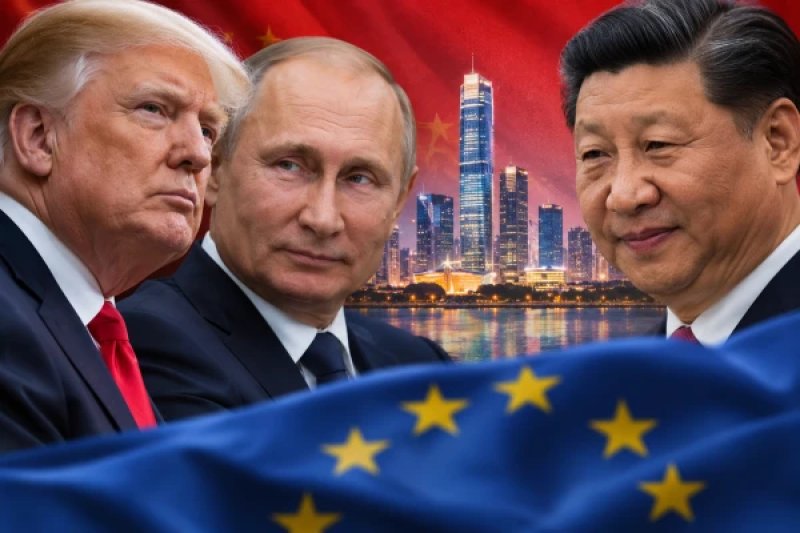
 Foto: BB.LV / Трамп, Путин и Си Цзиньпин
Some analysts are already comparing the negotiations to the Yalta Conference of 1945, when the great powers determined the post-war order of the world. French political analyst Sébastien Boussois writes about the dangers of such a scenario in an article for Entrevue. Some analysts are already comparing the negotiations to the Yalta Conference of 1945, when the great powers determined the post-war order of the world. French political analyst Sébastien Boussois writes about the dangers of such a scenario in an article for Entrevue. ## New Yalta: Why Europe Fears the Meeting of Three Leaders On November 18, a meeting began in Shenzhen, China, between U.S. President Donald Trump, Russian President Vladimir Putin, and Chinese President Xi Jinping. The negotiations are taking place on the sidelines of the Asia-Pacific Economic Cooperation (APEC) summit. Formally, the absence of representatives from the European Union is understandable: European states are not part of this organization. However, the issues that the three leaders may discuss directly affect Europe’s interests. Primarily, this concerns the war in Ukraine, international security, and the future of relations between the largest world powers. This is why some observers compare the meeting to the Yalta Conference of February 1945, when Joseph Stalin, Franklin Roosevelt, and Winston Churchill discussed the post-war order of the world. Of course, the historical circumstances today are completely different. However, the very possibility that several states will discuss the fate of other countries without their participation raises alarming associations. According to Boussois, the main danger lies not even in the specific agreements that may be reached in Shenzhen. The much more serious risk is the formation of a new model of international relations, where a few major powers effectively gain the ability to set the rules of the game for the rest. ## Three Powers — Three Different Interests Each participant in the negotiations has its own strategic objectives. For Washington, the priority remains international security, arms control, and the protection of American interests. Moscow seeks to strengthen its position on the world stage and achieve a more favorable balance of power in its relations with the West. Beijing, as the host, has the opportunity to emphasize its role as one of the main diplomatic centers of the world while simultaneously promoting its own strategic interests. Europe finds itself in a difficult position: decisions that could affect its security may be discussed without the direct involvement of European leaders. However, the author acknowledges that the meeting does not necessarily have to end with historic agreements. International summits often conclude with statements that lack significant practical results. But even in such a case, the very format of the negotiations can have great symbolic significance. ## Europe Has Relied on American Protection for Decades The French analyst believes that the current situation is a consequence of Europe’s long-standing dependence on the United States. After the establishment of NATO in 1949, a significant portion of Western European states built their security primarily on American military guarantees. After the end of the Cold War, many governments reduced defense spending, hoping that large-scale military threats were a thing of the past. At the same time, individual European countries retained significant military potential. France possesses its own nuclear deterrent forces, a developed defense industry, and the capability to conduct independent military operations. The United Kingdom, despite leaving the European Union, also remains one of the leading military powers on the continent. However, according to Boussois, the problem lies in the inability of European states to combine national resources into a truly effective collective security system. Increasing defense budgets alone does not solve this problem. Even allocating additional billions of euros cannot instantly create stockpiles of ammunition, prepare the necessary units, establish intelligence cooperation, and form a unified military command system. Moreover, purchasing weapons outside of Europe can maintain dependence on foreign suppliers. ## Trump Demands More from Europe — and There Are Grounds for This Demand The author notes that the American authorities have been urging European allies to increase their own defense spending for many years. At the NATO summit in The Hague in 2025, alliance states agreed on a new goal for 2035: to allocate 3.5% of GDP directly to defense and up to 1.5% to security-related expenses. However, this is about a long-term commitment, not about existing military capabilities. Boussois emphasizes that European states have the right to demand respect for their sovereignty and participation in negotiations that affect their interests. At the same time, the analyst believes it is difficult to expect fully equal relations with an ally when key elements of one’s own security depend on that ally. In his opinion, Washington's criticism does not replace the need to strengthen European defense. ## What Europe Must Change to Be Taken Seriously The French expert believes that European states need not only to increase military spending but also to reconsider their entire approach to ensuring security. First and foremost, European countries should define common strategic interests that they are willing to defend together. It is necessary to expand the production of weapons and ammunition, coordinate defense procurement, eliminate the most serious technological dependencies, and create mechanisms for joint decision-making. Equally important is the political question: who exactly has the right to negotiate on behalf of Europe, and what mandate should such a representative possess? According to Boussois, European states must be capable of acting independently in situations where Washington prefers not to intervene. This does not mean breaking relations with the United States. On the contrary, true European independence, the author believes, would allow for the creation of a more balanced alliance in which Europe could not only follow Washington's decisions but also participate in their formation and, when necessary, defend its own position. ## The Main Danger — Being Left on the Sidelines of World Politics The meeting in Shenzhen, according to the French analyst, may serve as yet another reminder of how much the international system has changed. The previous mechanisms of multilateral cooperation are increasingly being replaced by the rivalry of major powers striving to consolidate their spheres of influence. In such a system, states lacking sufficient political, economic, and military independence risk losing the ability to influence decisions that directly affect their future. For Europe, this is particularly sensitive, as it concerns not only economic interests but also the war in Ukraine, the security of NATO's eastern borders, and the future of European security architecture. Boussois warns: if European countries cannot overcome internal disagreements and strengthen their own capabilities, they risk being permanently relegated to the periphery of world politics. And then the main question will no longer be why Europe was not invited to the negotiating table, but why it failed to secure the right to determine its own future.
