

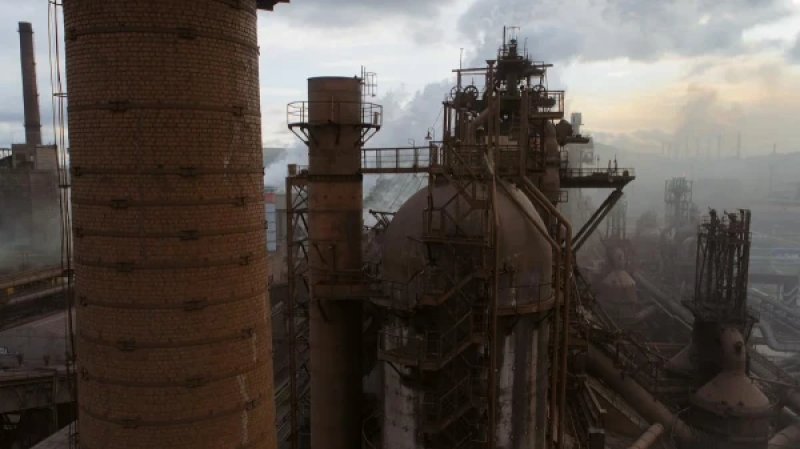
 Foto: BB.LV / Заводские сооружения
They describe the situation as critical: steel production is coming to a halt, mines are not operating at full capacity, investments are being frozen, and thousands of workers are living in uncertainty. In Kamenskoye, steel production has ceased since the beginning of autumn. Russian missiles and drones have damaged critical parts of the plant, and the restoration of just one destroyed furnace could cost tens of millions of dollars, the publication writes. "If we lose workers, money will no longer matter. Then we will never be able to resume the operation of the plants," said the head of the enterprise, Alexander Tretyakov, in a comment. According to DN, before the full-scale invasion, heavy industry accounted for more than 10% of Ukraine's GDP. By 2025, its share had roughly halved, and as of September 2026, steel production in the country had fallen by more than 80%. The crisis is already extending far beyond the plants themselves. Nearly half of the 200,000 residents of Kamenskoye are somehow connected to "Kamezstal," and tax revenues from the plant constitute a significant part of the city budget. At the same time, the situation in the mining sector is deteriorating. In Kryvyi Rih, some mines and quarries are operating at only 20–50% capacity due to the energy crisis, falling demand, export issues, and a shortage of locomotives following Russian attacks on the railway. "The industry is more dead than alive," described the situation by one of the leaders of the "Sukhaya Balka" mine. Another blow is the effective collapse of export logistics, DN notes: Black Sea ports are operating under serious restrictions, and transporting steel and ore overland is becoming increasingly difficult due to a shortage of locomotives. As a result, metallurgical and mining enterprises are forced to cut production just when they need to increase volumes to maintain competitiveness. DN reminds that before the war, Ukraine produced more than 21 million tons of steel per year and was among the largest producers in the world. In 2021, metal and ore accounted for about a third of the country's commodity export value. Now, the industry, which for decades has been one of the pillars of the Ukrainian economy, is effectively fighting for survival. Earlier, Ukrainian companies appealed to the government to create a separate support program for the industry similar to that for energy, as well as to temporarily ease trade restrictions for supplies to the EU. Without the restoration of production, logistics, and access to markets, Ukraine risks losing not only individual plants but also entire industrial cities, tens of thousands of jobs, and a significant part of its economic base for post-war recovery.
