

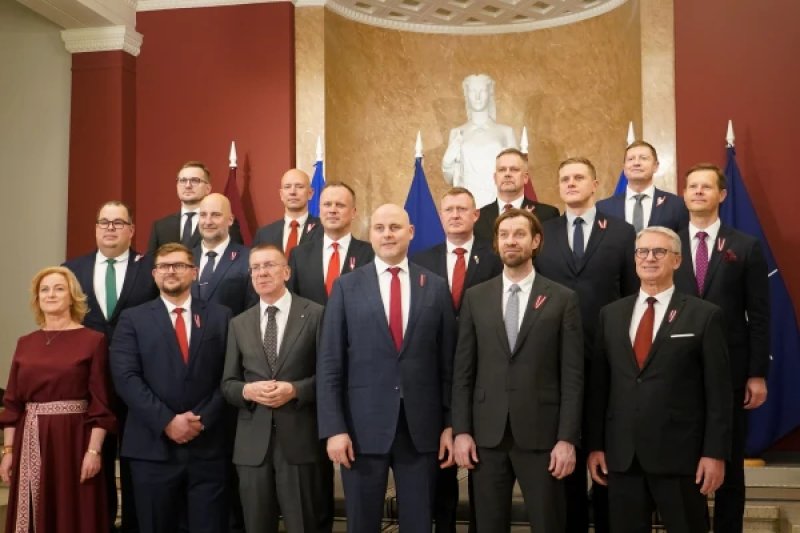
 Foto: BB.LV / Правительство Кулбергса
The new government of Latvia has included in its program further restrictions on the use of the Russian language in public spaces. One of the planned steps will be the adoption of a special "de-Russification declaration," which is intended to create a legal basis for the corresponding changes. According to the LETA agency, such an obligation is contained in the declaration of the Cabinet of Ministers led by Andris Kulbergs, approved by the Saeima on November 17. The document outlines the main directions of the government's activities during the term of the 15th parliament. ### **What the "de-Russification declaration" entails** The section of the government program dedicated to language, media, and culture states the need to strengthen the role of the Latvian language as the sole state language. To this end, the government intends to adopt a separate declaration on de-Russification. The document states that the new approach should enshrine the recommendations of academics, historians, and sociolinguists and create a legal basis for restricting the Russian language in public spaces. However, the declaration does not clarify what specific restrictions are intended to be introduced. It does not specify whether the changes will affect commercial advertising, signage, customer service, cultural events, media, or other areas of public life. The timeline for developing the corresponding regulations has also not been indicated. Thus, this refers to a stated political intention of the government rather than already implemented restrictions. ### **The use of the Latvian language should increase at work and in public spaces** The government also intends to strengthen the use of the Latvian language in the information space and working environment. This direction is enshrined in a separate point of the declaration. Authorities view the state language as one of the foundations of national identity and state security. At the same time, specific measures that should ensure broader use of the Latvian language in workplaces and public life have not yet been presented. Implementing them may require changes to existing legislation and other regulatory acts. ### **State support promised for media operating solely in Latvian** A separate point of the declaration concerns the funding of media outlets. The government promises to support national, regional, and diaspora media that create content exclusively in the Latvian language. The document states that such support should ensure the production of quality, analytical, and diverse journalistic materials. However, it is not specified how the new wording will affect existing state support programs for media. In particular, it is currently unknown whether access to funding will be restricted for publications that produce materials in multiple languages, including Russian, or whether additional targeted programs will be created exclusively for Latvian-language content. The funding process and selection criteria for recipients of assistance will be determined separately. ### **The State Language Center is to be made independent** Another change concerns the State Language Center. The government proposes to transform it into an independent institution while simultaneously strengthening its capabilities and institutional neutrality. The declaration emphasizes that the state language is one of the fundamental values of the Constitution of Latvia. However, it does not clarify how the legal status of the center will change, to whom it will be accountable, and whether it will receive additional powers. In another section of the declaration, the government also promises to increase penalties for violations of state language requirements. The specific amounts of future fines and the list of violations are not provided in the document. ### **What will change in public media** Regarding public media, the new government promises to strengthen its political neutrality, diversity of opinions, and the role of the Latvian language. Additionally, special attention is planned to be given to the uninterrupted operation of the public broadcaster in crisis situations. The activities of public media must comply with national security requirements. However, the declaration does not contain a specific plan for changing the language structure of public broadcasting. ### **What else is promised in the field of culture** Language policy is only part of the section of the government declaration dedicated to culture and media. In particular, the cabinet intends to gradually increase the wages of cultural workers, bringing them closer to the levels of other Baltic countries and the average salary in the public sector. However, specific timelines for achieving these goals have not been established. The pace of salary increases will depend on the capabilities of the state budget. The government also promises to support the program for preserving sacred heritage and the tradition of the Song and Dance Festival. Additionally, the inclusion of culture as a component of national security in long-term national development documents — the "Latvia 2050" strategy and the National Development Plan for 2028–2034 — is specifically provided for. The declaration also mentions the need to strengthen democratic values, openness in public administration, and dialogue with civil society. ### **When new restrictions may appear** The government of Andris Kulbergs was approved by the Saeima on November 17. Fifty-seven deputies voted for the new cabinet, while thirty-four voted against. The coalition was formed by the "United List" and the National Alliance. The declaration defines the political commitments of the cabinet; however, it does not itself establish new prohibitions on the use of the Russian language. To introduce specific restrictions, it will be necessary to prepare the corresponding regulatory decisions, define their scope, and undergo the legislative procedures provided for. It is still unknown what specific proposals will be developed, when they may come into effect, and how they will affect the daily lives of Russian-speaking residents of Latvia.
