

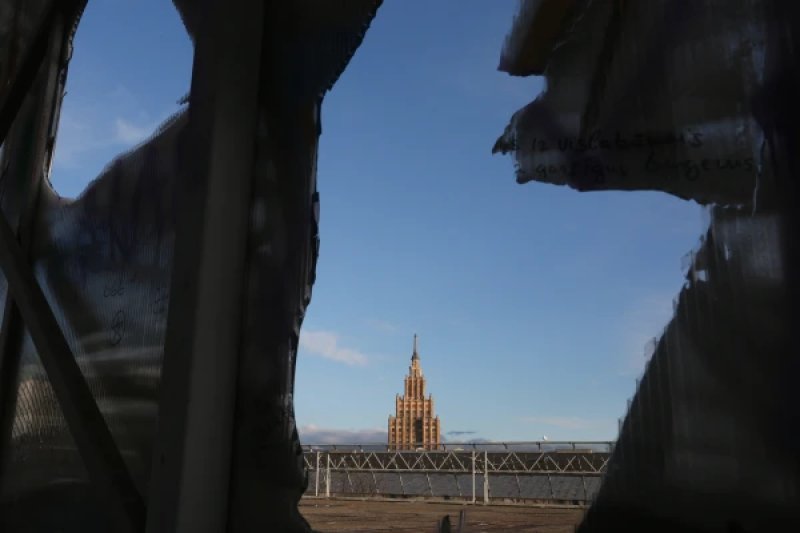
 Foto: BB.LV / Академия наук Латвии
The Latvian Academy of Sciences, which unites the leading scientists of the country, still cannot definitively determine its role more than three decades after the restoration of the state's independence. Its leadership faces criticism for insufficient transparency, the aging composition of its academics, and property management. The latest scandal surrounding the granting of Latvian citizenship to Indian citizen Divya Kanane Vishwanath has sparked renewed discussions about the future of the institution. As noted by Latvijas Avīze and the magazine Ir, questions about the need to reform the academy have arisen over the years, but many issues remain unresolved. ### The fate of the academy president will be discussed on November 26 The next important event will be the general meeting of the Latvian Academy of Sciences, scheduled for November 26. The agenda includes a question about the dismissal of the current president of the academy, Ivars Kalviņš. The reason for the new crisis was the scandal surrounding the recommendation to grant Latvian citizenship to Indian citizen Divya Kanane Vishwanath for special merits to the state. On October 15, the Saeima supported granting her citizenship, but soon doubts arose about the authenticity of the information regarding the researcher’s scientific achievements. On October 22, the parliament revoked its own decision. Kalviņš, who supported Vishwanath's candidacy, subsequently appealed to the academy's senate to consider the question of his dismissal, as previously reported by [BB.lv](https://bb.lv/statja/nasha-latvija/2026/10/23/skandal-s-grazdanstvom-nabiraet-oboroty-prezident-akademii-nauk-latvii-zadumalsia-ob-otstavke?utm_source=chatgpt.com). At the same time, the academy's senate stated that it did not have evidence that the president had knowingly exceeded his authority or acted out of personal interest. Nevertheless, the leadership acknowledged that what happened created serious reputational risks. The final decision regarding Kalviņš's future work will be made by the academy members. ### The state wants to reconsider the role of the academy The scandal has led to broader consequences. At the initiative of the Ministry of Education and Science, a comprehensive assessment of the academy's activities, its legal status, management system, and place in the scientific life of Latvia is being prepared. This involves the creation of an interdepartmental commission with representatives from the scientific community, universities, and government institutions. The commission is to assess how well the current model of the academy meets the needs of the modern system of science and innovation. More details about this have already been reported by [BB.lv](https://bb.lv/statja/politika/2026/11/18/posle-skandala-s-grazdanstvom-vlasti-latvii-vzialis-za-akademiiu-nauk-cto-sobiraiutsia-izmenit?utm_source=chatgpt.com). It is expected that proposals for possible changes will be presented to the government by May 31, 2027. However, this currently concerns assessment and preparation of recommendations, rather than a decision to liquidate or reorganize the academy. ### A problem warned about back in 1991 One of the longstanding problems of the academy is the aging of its members and insufficient active recruitment of young scientists. Back in 1991, when the reorganization of the institution began, academician Jānis Stradiņš warned that the academy needed to renew itself, or it risked becoming a "club of gerontologists." Ten years later, he acknowledged that the situation had not improved: academy members were aging even faster than the scientific community of Latvia as a whole. According to data from 2018–2020, the average age of academics in the Department of Physical and Technical Sciences was about 72 years, while that of corresponding members was 62 years. These figures relate to the previous period and do not reflect the current age composition of the academy. However, they show how long the issue of generational change has been discussed. For decades, the idea of creating an Academy of Young Researchers has been proposed. However, this initiative faced objections from young scientists themselves, who feared that the new structure would not be an independent organization but rather a division subordinate to the leadership of the Latvian Academy of Sciences. As a result, the issue of attracting a new generation of researchers remains relevant. ### The skyscraper in the center of Riga — a symbol and a financial problem Another constant subject of dispute is the academy's building on Akademijas Square in Riga. The monumental 21-story skyscraper with a spire height of 111 meters was built between 1951 and 1961 and has the status of a protected architectural monument of local significance. It is one of the most recognizable architectural objects in the capital. However, the building is too large for the needs of the academy itself. A significant portion of the premises is not used directly for scientific activities, while the maintenance and servicing of such a large building require ongoing expenses. For many years, there have been disputes about whether the institution should retain the historical skyscraper or seek more compact premises. In 2022, the building was transferred to the ownership of the Latvian Academy of Sciences. The Ministry of Education and Science opposed this decision, believing that using such a large object for the needs of the academy was economically unfeasible. Nevertheless, the academy retained its historical headquarters while also taking on the responsibility for managing and maintaining the property. ### There is less money, and previous powers are gone After the restoration of Latvia's independence, the position of the Academy of Sciences in the state system changed. During the Soviet period, the academy had significant scientific institutions, financial resources, and administrative powers. After the reform of the scientific system, its role changed: today, it is primarily an association of scientists performing expert, representative, and advisory functions. At the same time, the financial support for the academy remains a subject of disputes. The institution's leadership has repeatedly pointed out that during the economic crisis of 2008, the state subsidy was cut by about half and has not significantly increased since then. The lack of resources limits the ability to develop new areas of activity and support scientific initiatives. At the same time, the academy has to deal with economic issues related to the maintenance of a large building. ### What will happen to the Academy of Sciences The upcoming assessment should help determine what role the academy should play in modern Latvia. Among the questions are management efficiency, funding, cooperation with universities and research institutes, attracting young researchers, and the use of the academy's property. Against this backdrop, the decision regarding Ivars Kalviņš's future may only be the first step toward broader changes. However, the mere change of president will not automatically resolve the problems that have accumulated over decades. The main question remains the same: can the Latvian Academy of Sciences become an influential center for scientific expertise and a unifying body for researchers, or will it continue to exist in its current model, the effectiveness of which is increasingly being questioned.
