

 Foto: BB.LV / Земля
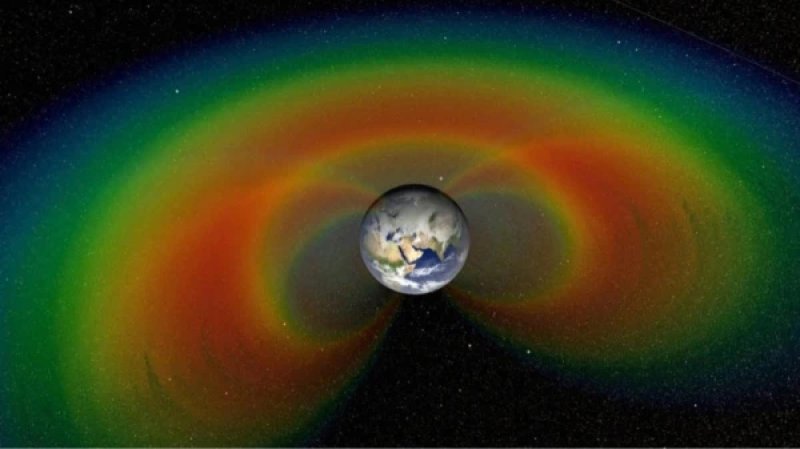
### Invisible Rings Around Our Planet At first glance, the space around Earth seems empty. In reality, it is filled with charged particles, the movement of which is determined by the interaction of the planet's magnetic field with the solar wind and other cosmic processes, writes [Space](https://www.sciencealert.com/for-the-first-time-4-radiation-belts-appeared-around-earth-in-2024). Back in 1958, the American satellite Explorer 1 helped discover the radiation belts, later named after physicist James Van Allen. Typically, two main belts are distinguished. The inner one predominantly contains high-energy protons, while the outer one contains high-energy electrons. They take the form of giant rings resembling bagels and surround Earth at distances of thousands of kilometers. The magnetic field keeps the particles in specific areas of near-Earth space, preventing them from moving freely in all directions. However, this system is far from constant. Under the influence of solar activity, the number of particles and their distribution can change dramatically. This is exactly what happened after an exceptional geomagnetic storm in the spring of 2024. ### The Solar Storm Triggered an Unusual Process On May 11, 2024, Earth experienced one of the most powerful geomagnetic storms in the last two decades. The event, dubbed the "Mother's Day Storm," was accompanied by strong disturbances in the magnetosphere and significant changes in the flow of charged particles. Researchers expected that after such an impact, the structure of the radiation belts would change. However, the observational results were unexpected. Initially, three separate electron belts formed around Earth. Then, by June 2024, scientists discovered four. Such a configuration had never been recorded in the entire history of observations. Moreover, the additional belts did not arise at the moment of maximum solar activity but rather some time after the storm. By August 2024, the system gradually returned to its usual structure. Thus, the unusual state of the magnetosphere persisted for a limited time but allowed scientists to observe processes that had previously remained insufficiently studied. ### How Did Scientists Discover the Fourth Belt? The study, published in the journal [npj Space Exploration](https://doi.org/10.1038/s44453-026-00064-7), is based on data from the Energetic Particle Telescope (EPT) instrument. It is installed on the European Space Agency's PROBA-V satellite, which orbits in a polar sun-synchronous orbit at an altitude of about 820 kilometers. The instrument measures the characteristics of energetic particles, allowing for tracking changes in the radiation environment. Analysis of the obtained data showed that after the May storm, the distribution of electrons around Earth became unusually complex. Instead of the usual two main areas of concentration of high-energy particles, additional zones appeared, separated by gaps with lower electron content. It was these gaps that allowed researchers to identify four separate electron belts. The lead author of the study, Viviane Pierrard from the Royal Belgian Institute for Space Aeronomy, noted that such observations prompt a reevaluation of processes in the magnetosphere. > "It is surprising that we discovered four belts, while recently we have often observed three, whereas previously only two were recorded. This indicates that new mechanisms for the loss or capture of particles have recently emerged," the researcher told ScienceAlert. ### Why Did the Number of Belts Increase While Electrons Decreased? The most unusual feature of the discovery lies in the mechanism of forming additional belts. One might assume that a powerful solar storm simply brought in so many charged particles that new radiation rings formed around Earth. However, in reality, the process turned out to be more complex. After the initial increase in the number of electrons, their redistribution began. The interaction of particles with electromagnetic waves caused electrons to leave specific areas of the magnetosphere. Some of them scattered towards the Earth's atmosphere. As a result, within previously more continuous areas of electron concentration, peculiar voids appeared. It was these voids that separated the radiation structures into additional belts. In other words, the four belts formed not simply due to the accumulation of new particles but as a result of their selective removal from certain areas. Over time, electrons continued to move between various magnetic shells of Earth, and the initial structure gradually restored. ### Why Had This Not Been Observed Before? The appearance of additional radiation belts is not entirely a new phenomenon. As early as 2012, scientists recorded a temporary configuration of three belts. Similar structures were also observed after several strong geomagnetic storms in 2024–2026. However, four separate electron belts had not been detected until now. It is particularly interesting that during the peak of the previous, 24th solar cycle, which ended in December 2019, similar three-belt structures were not observed. At that time, flows of solar particles penetrated directly into the inner regions of the radiation belts, without creating such separation. According to researchers, the differences may be related to the characteristics of coronal mass ejections and the nature of the interaction of particles with electromagnetic waves. This means that even strong solar storms do not necessarily lead to the same consequences. Much depends on the specific conditions in the magnetosphere, the distribution of particles, and the processes that cause electrons to move or fall into the atmosphere. ### What Are the Dangers of Radiation Belts for Satellites? Although radiation belts are invisible, their existence has quite practical significance. High-energy electrons and protons can damage the electronics of spacecraft, disrupt sensor operations, and gradually degrade the performance of solar panels. Sometimes even a single energetic particle can cause a failure in sensitive electronic equipment. For satellites, it is particularly important not only the total amount of radiation but also the altitudes and areas of the magnetosphere where dangerous particles concentrate. If, after a geomagnetic storm, the radiation belts change shape and location, the operating conditions for spacecraft can also change significantly. This must be taken into account when designing satellites, choosing orbits, and planning space operations. ### What Does This Mean for Future Human Space Flights? Increased radiation levels pose a danger not only to technology but also to humans. Exposure to high-energy particles increases the radiation burden on astronauts' bodies and, at sufficiently high doses, can elevate the risk of long-term health consequences, including cancer and cataracts. Therefore, studying radiation belts is particularly important for future flights beyond low Earth orbit. Scientists need to understand how quickly the radiation environment changes after solar storms, where dangerous particle accumulations occur, and how long they persist. Researchers also note that the distribution of electrons is influenced not only by processes on the Sun. The properties of the Earth's atmosphere, plasma, electromagnetic waves, thunderstorm activity, and even some man-made radio transmission systems are significant. All these factors make the behavior of radiation belts much more complex than was thought in the early stages of space research. ### Earth Returned to Its Usual System, but the Mystery Remains By August 2024, the unusual configuration disappeared, and the distribution of electrons once again corresponded to the familiar two-belt structure. However, the discovery of four radiation belts raised new questions for researchers. First and foremost, scientists want to determine which specific combinations of solar activity and processes within the magnetosphere allow such unusual structures to form. Equally important is understanding why temporary additional belts have been observed more frequently in recent years than before. The authors of the study hope that further observations will help improve models of space weather and more accurately predict radiation conditions in near-Earth space. This is especially relevant against the backdrop of the increasing number of satellites and the preparation of new crewed missions. The discovery shows that even a seemingly well-studied area directly around Earth can surprise scientists.
