

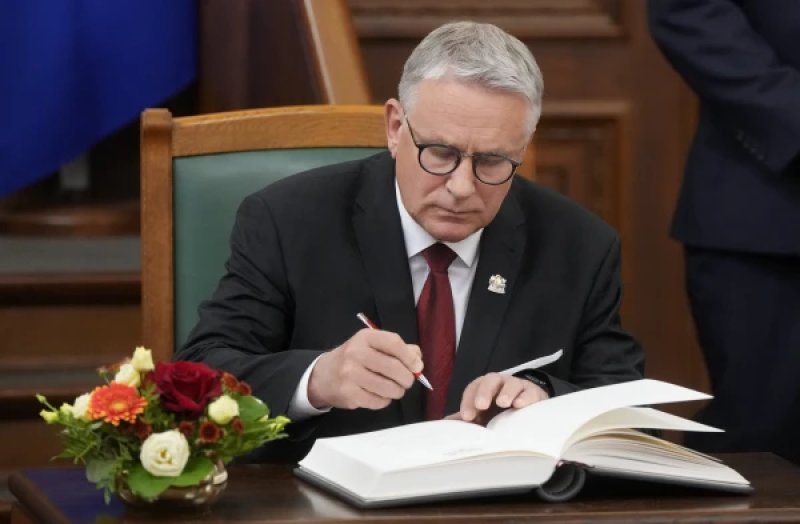
 Foto: BB.LV / Наурис Пунтулис
Latvian government institutions must cease the use of the Russian language in public communication with society. This position was expressed by Minister of Culture Nauris Puntulis ("National Alliance"), commenting on the new government's intention to create a legal basis for further restricting the Russian language in the public space. According to the LETA agency, citing the minister's advisor Agnese Varpinju, Puntulis believes that the refusal of government institutions to communicate in Russian is a necessary part of the de-Russification policy. ### What changes does the minister propose In Puntulis's opinion, one of the next steps should be the exclusion of the Russian language from public communication of state sector institutions. As an example, the minister cited already adopted decisions by the Ministry of Culture and the Ministry of the Interior, which is headed by his party mate Janis Dombrava. Both ministries had previously imposed restrictions on the use of the Russian language in performing public functions. Thus, this primarily concerns the language of official information, messages, advertising, and other forms of communication between institutions and society. At the same time, the minister did not present a new list of specific prohibitions that are intended to be applied to all public institutions. It is also still unknown whether exceptions will be made and how the authorities intend to regulate situations where residents need information in other languages. ### The Ministry of Culture has already abandoned the Russian language on websites and in advertising In June 2026, Puntulis signed an order requiring the Ministry of Culture, its subordinate institutions, and state enterprises to abandon the use of the Russian language in public communication. The requirements concerned, in particular, official websites, advertising materials, implemented projects, and organized international events. Institutions were to comply with the order by July 30. This decision sparked discussions, especially in the cultural sphere. One of the most notable examples was the Riga Russian Theater named after Mikhail Chekhov, whose management expressed concerns about the consequences of restricting Russian-language communication. The theater pointed out that the Russian language is associated not only with informing the audience but also with the cultural identity of the institution. The Ministry of Culture clarified that the order does not prohibit professional artistic activity in the Russian language if the work was originally created in that language. Thus, restrictions on public communication do not mean an automatic ban on performances or other artistic works in the Russian language. ### From education to communication with the state Puntulis views the current initiative as a continuation of already implemented changes in language policy. One of the most important steps he named was the transition of the education system to the Latvian language and the cessation of education in Russian within the framework of previous national minority education programs. The next stage, according to the minister, was to establish requirements for the use of the state language by employees in professional communication. Now, attention is to be focused on public communication of government institutions. According to Puntulis, this sequence of measures should strengthen the position of the Latvian language as the only state language. ### What is provided for in the new government's program In the declaration of the government of Andris Kulbergs ("United List"), approved on November 17, there is a commitment to create a legal basis for restricting the use of the Russian language in the public space, as previously reported by [BB.lv](https://bb.lv/statja/politika/2026/11/19/novoe-pravitelstvo-latvii-obeshhaet-priniat-deklaraciiu-o-derusifikacii-russkii-iazyk-zdut-novye-ograniceniia). To this end, the authorities intend to adopt a special "declaration on de-Russification." According to the cabinet's program, the document should consolidate recommendations from academics, historians, and sociolinguists, as well as establish legal grounds for strengthening the status of the Latvian language. However, the government declaration does not explain what specific new restrictions will be introduced. It is also not specified how their implementation is to be ensured in practice. This means that the item contained in the program currently represents a political commitment of the government, rather than an already existing general ban on the use of the Russian language. ### When new rules may appear Puntulis himself admits that it is premature to name specific deadlines for the development and adoption of the de-Russification declaration. According to him, the decision regarding the document must be made by the Cabinet of Ministers or the Saeima. The minister believes that action must be decisive but also balanced. Therefore, it is still unknown when the government will present specific legislative proposals and which institutions they will affect. ### The idea was promoted back in 2025 The initiative to adopt a de-Russification declaration did not emerge now. In June 2025, shortly before the municipal elections, the "National Alliance" submitted a draft declaration to the Saeima regarding the criminal Russification of Latvia during the Soviet occupation and the elimination of its linguistic consequences. Party representatives then stated that such a document should become the legal basis for the consistent restriction of the use of the Russian language in the public space. The initiative was also supported by some representatives of the "United List." Now the corresponding intention is included in the program of the new government, which involves both political forces. ### What this means for residents At this stage, from the minister's statements, it follows that the authorities want to expand the approach already applied in certain departments to official public communication. This may affect the content of government websites, informational materials, and other messages from institutions to the population. However, specific rules have not yet been developed, so it is impossible to assert that all institutions are already required to abandon the Russian language or that residents will be prohibited from addressing them in Russian. No new restrictions on the use of the Russian language in private communication have been announced either. Key questions — what specific types of information will be subject to restrictions, whether there will be exceptions, and how the authorities will ensure the accessibility of public services — remain open. Answers to them should emerge during the development of the promised government declaration and subsequent legal decisions.
