

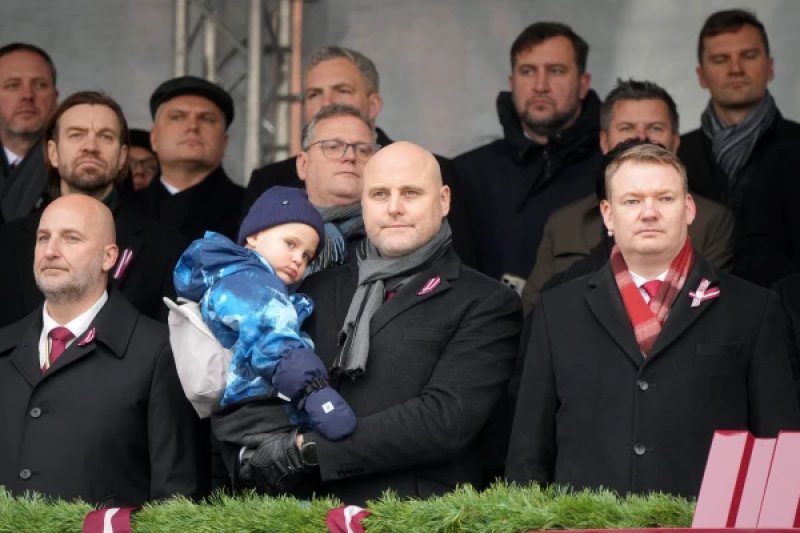
 Foto: BB.LV / Кулбергс с сыном
Should the Prime Minister leave his child at home when attending a public event, or is he entitled to combine state duties with family care? In Latvia, the discussion continues around the head of government, Andris Kulbergs ("United List"), who has appeared in public several times in recent weeks with his three-year-old son. According to [TV3 News](https://tv3.lv/zinas/latvija/sabiedriba/kulbergs-publiskos-pasakumos-ar-delu-sabiedriba-uzvirmo-diskusijas-par-robezam/), the discussion has gone beyond evaluating the behavior of one politician. It has touched on a broader question: where are the boundaries between parental involvement in raising children, professional duties, and a child's right to privacy. ### First the protest in Jekabpils, then the military parade The reason for the debates was Kulbergs' participation in a protest against the transit of Russian grain through Latvia, which took place on November 7 in Jekabpils. The Prime Minister addressed the crowd while holding his three-year-old son. READ MORE >> [Did he hide behind his child? - Kulbergs' actions at the protest sparked a wave of criticism](https://bb.lv/statja/politika/2026/11/08/prikrylsia-rebenkom-deistviia-kulbergsa-na-akcii-protesta-vyzvali-skval-kritiki) This caused mixed reactions on social media. Some users felt that a child should not be at an event where an emotionally charged atmosphere is possible. Others suggested that the presence of his son could be used to create a positive public image for the politician. However, there were also those who supported the Prime Minister, reminding that caring for a child is just as much a father's duty as it is a mother's. Kulbergs later explained that he took on the care of his son that day so that his wife could prepare for the state holiday events. READ MORE >> [“Let me be a father!” - Kulbergs explained his presence with the child at the picket](hhttps://bb.lv/statja/politika/2026/11/16/pozvolte-mne-byt-otcom-kulbergs-obieiasnilsia-za-rebenka-na-pikete) But on November 18, the discussion flared up again. This time, the head of government watched the military parade celebrating the anniversary of the proclamation of the Latvian Republic with his son. ### Residents of Latvia are divided in their opinions Journalists asked passersby how they feel about parents bringing small children to work events. Opinions varied. One respondent, Henrijs, believes such behavior is quite natural. > "If a person has no one to leave the child with, where should they put them? They have to take them along if everyone is busy," he reasons. In his opinion, such situations allow the child to get acquainted with the surrounding world. Another resident, Silvia, admitted that she has mixed feelings: on one hand, a father's involvement in the child's life evokes a positive reaction, but on the other hand, questions remain. Santa also does not see a serious problem if parents consider the situation acceptable and the child is not in a dangerous or overly stressful environment. ### “A person in a high position must remember that they are an example” The head of the Latvian Parents' Organization, Inga Akmentina, emphasizes that active father involvement in upbringing deserves approval. However, in her opinion, parents need to consider the child's age and the nature of the event. A three-year-old child is not always capable of behaving as circumstances require. At this age, children can suddenly become tired, scared, upset, or refuse to comply with adults' requests. Therefore, the presence of a small child at an official event requires additional preparation. Akmentina also reminds that public officials bear special responsibility for their actions. > "People in high positions in Latvia definitely need to remind themselves: now you are an example," she notes. According to the organization leader, in such cases, it is useful to openly explain to the public why a particular decision was made and to acknowledge if circumstances did not unfold as planned. ### Psychologist: it is important to ask oneself why the child is present Doctor of Psychology, clinical psychologist Diana Zande points out that introducing children to their parents' professional life can be beneficial. The child gains new experiences, learns what adults do, and better understands the surrounding world. However, not all work situations are suitable for this. > "There are jobs where we can take a child with us, and sometimes there are emergencies when we really have to take a child with us," says the specialist. But there are also events where the presence of a child may be inappropriate regardless of the circumstances. Therefore, parents should ask themselves what exactly prompted the decision to take the child along. Zande suggests considering whether the adult is seeking additional public approval by appearing with the child. At the same time, the specialist does not claim that Kulbergs was guided by such motives. It is about general principles of parental decision-making. ### Five questions every parent should ask themselves According to the psychologist, before taking a child to work or an official event, it is helpful to assess several circumstances. The first question is whether it will be possible to fully perform professional duties while also ensuring the child's safety and well-being. The second is whether the event itself is suitable for the child's age and emotional needs. The third is whether the ongoing situation will disturb the child, for example, due to noise, a large number of people, or the need to stay in one place for a long time. The fourth is whether the child's presence will cause inconvenience to other participants in the event. Finally, it is worth thinking in advance about who can take care of the child if the parent needs to focus entirely on work. The more responsible the official task and the stricter the official protocol, the more important it is to consider such circumstances. ### A child has the right to their own boundaries The debates surrounding Kulbergs' appearance with his son also touched on the issue of children's privacy. For a public politician, participation in an event implies attention from journalists, photographers, and social media users. But a small child cannot fully appreciate the consequences of such attention and decide for themselves how public their life should be. Therefore, the responsibility for protecting the child's interests lies primarily with the adults. Experts emphasize that there is no universal rule allowing or prohibiting bringing children to work. It is more important to evaluate each situation individually, keeping the child's needs in mind. This, according to specialists, should remain the main criterion regardless of whether the parents are ordinary employees or state leaders.
