

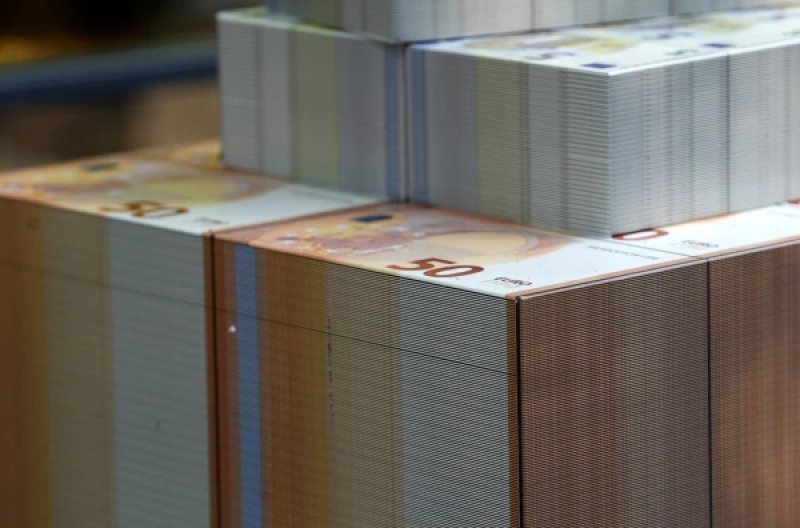
 Foto: BB.LV / деньги
The financial situation of Latvia's consolidated budget for the first ten months of 2026 turned out to be significantly better than a year ago. By the end of October, expenditures exceeded revenues by 447.9 million euros, while for the same period in 2025, the deficit was 810.6 million euros. According to the LETA agency, citing data from the Fiscal Discipline Council (FDC), the negative budget balance decreased by 362.7 million euros, or about 44.7%, over the year. The main reason for the improvement is the faster growth of revenues, primarily due to an increase in tax revenues and funds from the European Union. ### Why the Deficit Decreased From January to October 2026, the revenues of Latvia's consolidated budget grew by 8.2% compared to the same period last year. In monetary terms, the increase amounted to about 1.2 billion euros. One of the main factors was the inflow of funds from the European Union. Additional resources were also provided by the growth of tax revenues. At the same time, budget expenditures also increased, but at a slower rate — by 5.4%, or 835 million euros. Thus, the growth in revenues allowed for a partial offset of the increase in government spending and a reduction in the overall deficit. However, the improvement in indicators does not mean that the budget has become surplus: the public sector still spends more than it receives. READ MORE >> [After Last Year’s Deficit, Latvia’s Budget Has Again Become Surplus](https://bb.lv/statja/politika/2026/09/21/posle-proslogodnego-deficita-biudzet-latvii-vnov-stal-proficitnym) ### The Main State Budget Went into the Red by 1.1 Billion Certain parts of Latvia's budgetary system finished the ten months with a positive balance. In the special state budget, which finances a significant portion of social payments, a surplus of 487.8 million euros was formed. Municipal budgets showed revenues exceeding expenditures by 110.1 million euros. Another 77 million euros in surplus was recorded in the budgets of derived public entities. However, the main state budget remains significantly in deficit: by the end of October, its negative balance reached approximately 1.1 billion euros. This is why the positive results of individual parts of the budgetary system could not fully compensate for the shortfall in the main budget. ### What the Government Is Spending More On The Fiscal Discipline Council highlights three main areas of increased spending. First of all, expenditures on social benefits have risen. This means an increase in government payments to the population provided for by relevant programs. Another important factor is capital expenditures, including funds directed towards investment projects and the creation or renovation of infrastructure. The third reason is the increase in interest expenses related to servicing the government's debt obligations. At the same time, in some areas, expenditures have been reduced. In particular, costs for the purchase of goods and services, as well as current payments to the European Union budget, have decreased. Labor costs in the public sector, subsidies, and grants increased relatively moderately. As a result, the overall growth rate of budget expenditures was lower than the growth rate of revenues. ### How Much Has Already Been Spent from the Planned Annual Budget The budget law for 2026 provides for consolidated budget expenditures of 20.9 billion euros. According to the Fiscal Discipline Council's calculations, the first ten months of the year should account for about 16.3 billion euros. Actual expenditures turned out to be 89.3 million euros, or 0.5%, lower than the projected level. This is a relatively small deviation. Experts note that the execution of expenditures is gradually approaching planned indicators, and the data for ten months do not yet indicate a significant deviation from forecasts. By the end of October, the public sector had spent 78% of the annual budget, while revenues reached 82.9% of the planned annual amount. ### Why the End of the Year May Change the Picture Despite the improvement in indicators compared to 2025, the final results of the budget year are still unknown. In the last months, expenditures may increase as government programs, purchases, and investment projects come to an end. However, the authorities have already taken measures aimed at curbing costs. On October 13, the Cabinet of Ministers decided to limit the conclusion of new contracts and expenditures from the main state budget for purposes that are not essential for fulfilling the core functions of the state. According to the Fiscal Discipline Council, such a decision may help contain expenditure growth at the end of the year. ### Does This Mean That Budget Problems Have Decreased The reduction of the deficit in the first ten months is a positive change compared to last year, but it does not eliminate the long-term problems of public finances. Part of the increase in revenues is associated with the inflow of European funding, the volume of which may decrease in the coming years. At the same time, expenditures on social obligations, investments, and servicing public debt remain. The Fiscal Discipline Council has previously warned that Latvia needs not only to control current expenditures but also to seek sustainable sources of income over a longer period. Therefore, the result of the ten months should not be perceived as a forecast of the final deficit for the entire year of 2026. Nevertheless, the current indicators suggest that, for now, the revenue side of the budget is performing faster than the expenditure side, and the financial gap has significantly decreased compared to last year. READ MORE >> [How to Plug the Budget Hole: Latvia's Revenues Are Hopelessly Lagging Behind Expenditures](https://bb.lv/statja/ekonomika/2026/10/17/cem-zatknut-dyru-v-biudzete-doxody-latvii-beznadezno-otstaiut-ot-rasxodov)
