

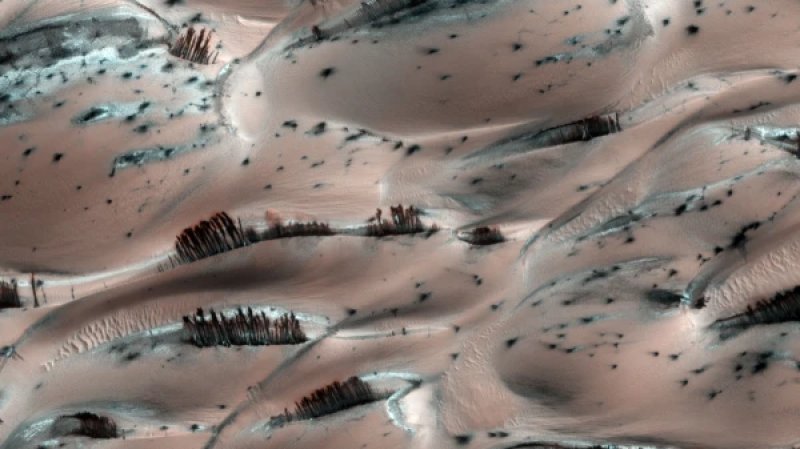
 Foto: BB.LV / лес на Марсе
### Where Did the 'Trees' on Mars Come From? The photograph, reminiscent of a scene from a science fiction movie, was taken by NASA's Mars Reconnaissance Orbiter back in 2008, as reported by [ScienceAlert](https://www.sciencealert.com/nasa-orbiter-snaps-what-looks-like-an-eerie-forest-growing-on-the-frozen-dunes-of-mars). It shows bright frozen dunes near the north pole of Mars. Long dark streaks stretch along their slopes, which at first glance look like the trunks and branches of trees. Some of these formations resemble dense thickets, as if they are growing directly from the sand. However, the secret of the image lies in the angle. The orbiter's camera was looking at the planet's surface from above. What appears to be vertically standing trees is actually dark sand that has cascaded down the slopes of the dunes. If the photograph is flipped, the illusion becomes much less convincing: instead of a forest, the movement of sand is more clearly visible. No evidence of trees or other vegetation on Mars has been found by scientists. ### Martian Spring Is Nothing Like Earth’s To understand the origin of this unusual landscape, it is necessary to consider the climate characteristics of the Red Planet. Like Earth, Mars has a tilted axis of rotation, so it also experiences seasons. However, due to its thin atmosphere and extremely low temperatures, seasonal processes occur differently there. During Martian winter, carbon dioxide from the atmosphere freezes, forming snow and frost made of dry ice on the surface. This is particularly noticeable in polar regions, where the ice cover spreads over large areas. With the arrival of spring, solar radiation gradually warms the surface. But instead of the usual melting, sublimation occurs: solid carbon dioxide directly turns into gas, bypassing the liquid phase. This process triggers a chain of events that creates unusual dark patterns on the dunes. READ MORE >> [29 Mysterious Glaciers with Cliffs Over 200 Meters High Discovered on Mars](https://bb.lv/statja/tehno/2026/11/18/na-marse-obnaruzili-29-zagadocnyx-lednikov-s-obryvami-vysotoi-bolee-200-metrov) ### Gas Accumulates Under the Ice Cover In spring, sunlight can penetrate through the relatively transparent layer of carbon dioxide ice and heat the dark soil beneath it. The ice begins to sublimate from below, and the gas that forms accumulates under the frozen surface. Gradually, the pressure increases. When the icy crust cracks, gas bursts out, sometimes carrying sand and dust particles with it. At the same time, the weakening of the ice cover contributes to the collapse of material on the steep slopes of the dunes. The dark sand moves downward, leaving long trails on the light surface. From a distance, they resemble branching tree trunks, although in reality, they are the traces of small sand avalanches. Moreover, these processes have not only been theoretically explained but also directly captured in photographs. ### NASA Managed to Capture a Real Sand Avalanche In the 2008 photograph taken by the high-resolution HiRISE camera, scientists noticed a small cloud of dust. It was caused by the movement of material down the dune slope. Thus, the orbiter captured not just the traces of a past collapse but also signs of the process itself. Later, researchers sought to determine how quickly such phenomena can change the Martian landscape. In a 2011 study, a team of scientists led by planetary scientist Candice Hansen-Koharchik from the Planetary Institute compared images of northern dunes taken over several Martian years. It turned out that seasonal changes can be quite significant. New breaches and depressions appeared on some dunes, while fresh deposits of sand accumulated at the foot of others. Researchers also found that on five studied dunes, the lower boundary of the slopes shifted by distances ranging from 2.2 to 4.7 meters in just one Martian year. This shows that the surface of Mars does not remain unchanged for thousands of years. Even under current climatic conditions, active geological processes are occurring there. READ MORE >> [Hot Magma May Be Hidden Beneath Mars' Surface: New Discovery Changes Views of the Red Planet](https://bb.lv/statja/tehno/2026/11/05/pod-poverxnostiu-marsa-mozet-skryvatsia-goriacaia-magma-novoe-otkrytie-meniaet-predstavleniia-o-krasnoi-planete) ### Why Does the Mysterious 'Forest' Disappear? The unusual Martian trees have another feature: they exist for only a limited time. As summer approaches, seasonal carbon dioxide ice completely disappears from the surface of the dunes. The dark streaks gradually lose contrast, and the wind redistributes the sand, smoothing out the traces of collapses. As a result, the landscape that resembled a fantastic forest changes. But with the onset of the next winter, the dunes are once again covered with dry ice. When spring returns, the processes of sublimation, cracking of the ice crust, and movement of sand can repeat. Therefore, such structures can appear again, although their shape and location may differ from the previous season. ### Why Are These Images Important for Science? Photographs of Martian dunes allow scientists to observe how climatic processes directly affect the planet's relief. Of particular interest is the role of carbon dioxide ice, which does not participate in seasonal landscape changes on Earth to such an extent. By comparing images taken in different years, researchers can assess the speed of sand movement, study slope stability, and better understand the interaction between the atmosphere and the surface of Mars. Such observations also help distinguish traces of modern processes from older geological formations. And although there is not a single real tree in NASA's photograph, the image demonstrates how unusual the nature of another planet can be. Mars remains a world without discovered vegetation, but its frozen dunes are capable of creating landscapes every spring that strikingly resemble Earth’s forests.
