

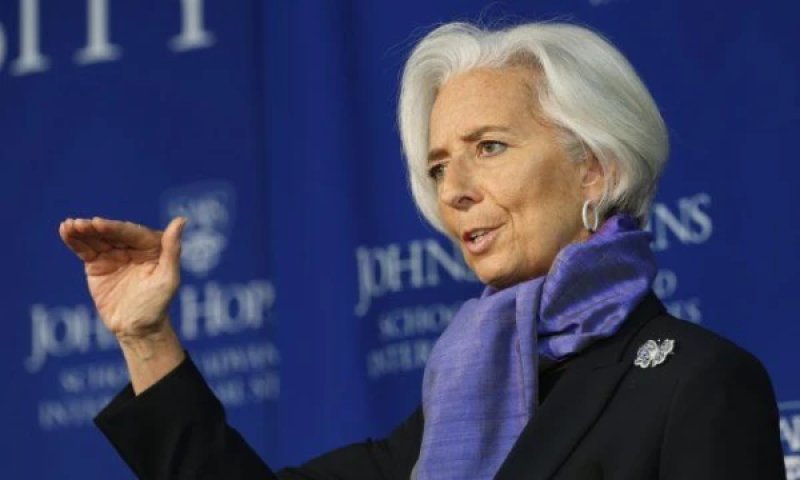
 Foto: BB.LV / Кристин Лагард
Christine Lagarde's decision to leave her position as President of the European Central Bank early has reignited speculation about whether she could run for the position of the first female president in France's history or play a key role in the upcoming presidential election race. Interest in Lagarde's next step is also high because the former minister does not have a clear party affiliation, which means she could be seen as a potential unifying figure for the fragmented centrist camp. This is particularly important in the context of the deeply polarized political climate in the country just five months before the presidential elections. At the same time, analysts warn that Lagarde's support remains largely limited to an educated "elite" electorate, and her high ratings in opinion polls reflect more a lack of direction among the French right than genuine enthusiasm for her potential candidacy in the presidential race. For instance, a poll published by Politico on November 11 showed that she could perform on par with right-leaning candidate, former Prime Minister Édouard Philippe, who is currently running third in the election race. When compared individually to other presidential candidates, they garnered 13.5% and 14%, respectively. The same poll confirmed that the undisputed leaders of the election race remain Marine Le Pen of the far-right "National Rally" and Jean-Luc Mélenchon of the far-left party "La France Insoumise." They are polling at approximately 32-34% and 17-19.5%, respectively, according to a poll conducted on November 18 by the Ifop-Fiducial institute. More moderate candidates, both from the right and left political spectrum, lack such electoral support. ## ## Lagarde: "I Don't Think I Can Remain Neutral" Before heading the ECB, Lagarde led the International Monetary Fund and served as France's Minister of Economy from 2007 to 2011 under the presidency of classical right Nicolas Sarkozy. Announcing her decision to step down as ECB president on October 29, she stated that she wants to gain freedom and "focus on issues that are not related to monetary policy." "I don't think I can remain neutral," she said, adding that she is interested in the truth, which "very often suffers when contradicted due to distortions." However, until her term as ECB president expires in February 2027, just two months before the first round of elections in France, she remains subject to the requirement of political neutrality. In response to a question about a possible candidacy, she told Euronews in July: "I am not a candidate, but it is very important to me that Europe is protected, that Europe remains the framework within which member states, including France, operate." In August, the Swiss newspaper Neue Zürcher Zeitung reported that Lagarde was referred to as a "potential candidate" for the head of the World Economic Forum during a council meeting near Geneva. Citing anonymous sources, the publication claims that Lagarde, who is a member of the WEF Board of Trustees, thanked her council colleagues for their trust and said she is "ready to serve." Last month, she told the French newspaper La Croix that her candidacy "would be a bad idea," noting: "There is a question of vitality, energy, and strength. There is also an inevitable sense of sacrifice with such a type of commitment. And I am 70 years old." ## ## The French Center and the Right in Search of Direction According to Bruno Cotres, a researcher at the Cevipof institute and a lecturer at Sciences Po Paris, Lagarde's ratings reflect "the loss of direction among the French right, rather than a deep commitment to the idea of Christine Lagarde as president." She may resonate with centrist and conservative voters, "who are financially secure, educated, and concerned about public debt," while another segment of voters "is likely not to have followed her career and does not actually know who she is." Lagarde's extensive experience at the IMF and ECB may enhance her appeal to some voters, but for others, it may reinforce the image of a detached "technocrat" - a criticism that also haunts French President Emmanuel Macron. Her high status in international institutions could turn into a double-edged sword, considering that "she will be perceived as part of the elite that society holds responsible for the current economic situation," Cotres noted. "She has lived abroad for fifteen years, working in prestigious international institutions where she earns very well. The question arises as to how well she can understand French voters and the population," he added. ## ## "She Will Not Take Votes from Mélenchon or Le Pen" Ultimately, Lagarde's candidacy will not "take votes from Mélenchon or Le Pen." This was stated by Euronews by Bernard Dolez, a professor of political science at the University of Paris 1 Panthéon-Sorbonne. She is likely to attract voters inclined to support centrist Gabriel Attal and right-leaning Édouard Philippe, both of whom served as Prime Minister under Emmanuel Macron. "The task of any candidate at this stage in the central-conservative block is to reach beyond their existing base. This is a serious challenge, as current candidates, including Glucksmann, Philippe, Attal, Retayo, and even recognized figures, are struggling with this," Dolez commented. Over the past decade, the political landscape of the country has changed, spurred by the election of centrist Emmanuel Macron in 2017, who split traditional right and left with his newly formed party. While the central and conservative blocks of France are trying to strengthen their positions, they remain divided over the issue of holding primaries to nominate a single candidate. Disputes also concern the inclusion of politicians from the far-right spectrum in potential primaries. Public debt remains a key campaign issue. Given that she is not an official candidate and has not presented a program, Lagarde's views remain a mystery, except for her pro-European approach, as well as her support for budget discipline and structural reforms. Nevertheless, France's public debt and fiscal crisis have become one of the main themes of the campaign, as the government attempts to push through the 2027 budget in a divided parliament. Proposed austerity measures have faced sharp criticism from opposition parties and unions amid serious social unrest. This is occurring against a backdrop of protests that began in secondary schools and evolved into a broader movement fueled by the cost of living crisis and rising energy prices, exacerbated by the war in Iran and the closure of the Strait of Hormuz. Bernard Dolez emphasized that "economic leaders both domestically and abroad are counting on the emergence of a charismatic figure who could become their savior." In September, Lagarde criticized Mélenchon's proposal to write off part of the French debt held on the ECB's balance sheet, warning that such a move would violate EU treaty provisions and undermine the trust of financial markets. The potential victory of Le Pen worries markets, which fear that her economic policies could complicate efforts to reduce France's public debt, increase borrowing costs, and create additional uncertainty in the eurozone.
