

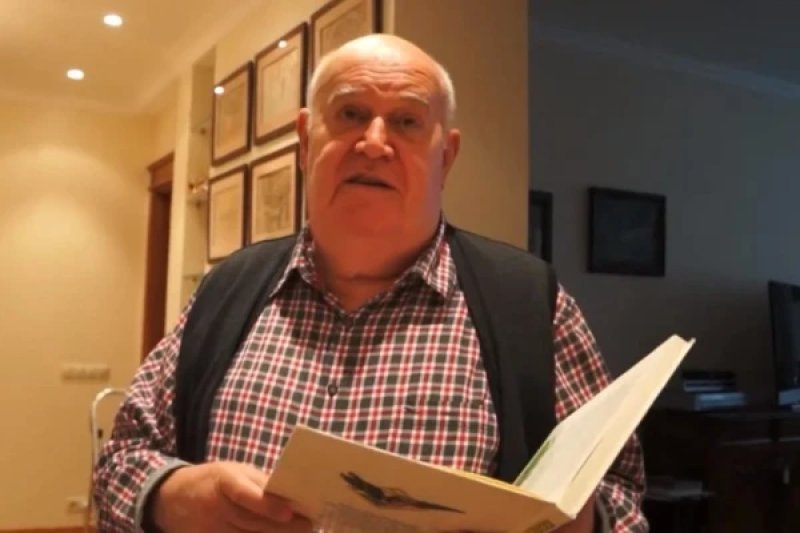
 Foto: BB.LV / Альберт Иванов
**From 'Seven Old Men' to the Famous Ostrich** Albert Ivanov was born on June 5, 1938, in the village of Ozherye in the Moscow region to a family of teachers. He spent his childhood and youth mainly in Voronezh, where he graduated from the Faculty of Philology. Later, he received a screenwriting education at VGIK and worked as an editor at Mosfilm for several years. Films such as 'Seven Old Men and One Girl', 'Three Days in Moscow', 'All Hands on Deck!', and 'Let's Talk, Brother...' were made based on his scripts, including those co-written with others. However, Ivanov gained particular fame for his cartoons. One of the most unusual was 'Wings, Legs, and Tails', in which a vulture tries to teach an ostrich to fly. The absurd humor, witty dialogues, and the famous phrase 'Better to lose one day, then fly in five minutes!' made the cartoon a true classic of Soviet animation. **How Khoma and Suslik Came to Be** The writer's most beloved characters became the hamster Khoma and his best friend Suslik. Ivanov first invented stories about their adventures back in 1975 and returned to these characters for decades. According to the author, he searched for a unique character for children's fairy tales for a long time. Bears, hares, and wolves were already too popular, and one day he came up with the idea of making a hamster the main character. The name Khoma was chosen by the writer for its similarity to the Latin Homo — 'man'. Soon, the hero had a loyal companion, Suslik. The adventures of the two friends turned out to be both funny and educational. The characters constantly found themselves in ridiculous situations, argued, schemed, and got upset with each other, but invariably found a way to make up. At the same time, Ivanov's early fairy tales were not readily accepted by publishers. Editors sometimes suspected hidden political subtext in the harmless children's stories. **A Fairy Tale That Ended in a Court Case** In 2016, the writer's name unexpectedly found itself at the center of a major scandal. In the collection 'The High Rock of Khoma and Suslik', a fairy tale titled 'How Suslik Got Stoned' was published. In the story, the hero became addicted to cannabis, and his friends tried to help him get rid of the dangerous habit. After a complaint from a parent, law enforcement became interested in the book's content. An examination and subsequent trial found propaganda for drugs in the work. As a result, the books were withdrawn from sale, and the publisher was fined. Ivanov himself was shocked by such a decision. He insisted that the meaning of the fairy tale was precisely in the fight against drugs, not in their popularization. The writer even cited works about Sherlock Holmes, where the use of narcotic substances was mentioned, questioning why a similar approach was not applied to classical literature. Despite this scandal, Ivanov's work continued to be popular. His fairy tales were repeatedly reissued, and the cartoons remained favorites among viewers of different generations. Albert Ivanov dedicated most of his life to children's literature. His characters taught friendship, kindness, and the ability to admit mistakes — without boring moralizing, but with humor that was understandable to both children and adults.
