

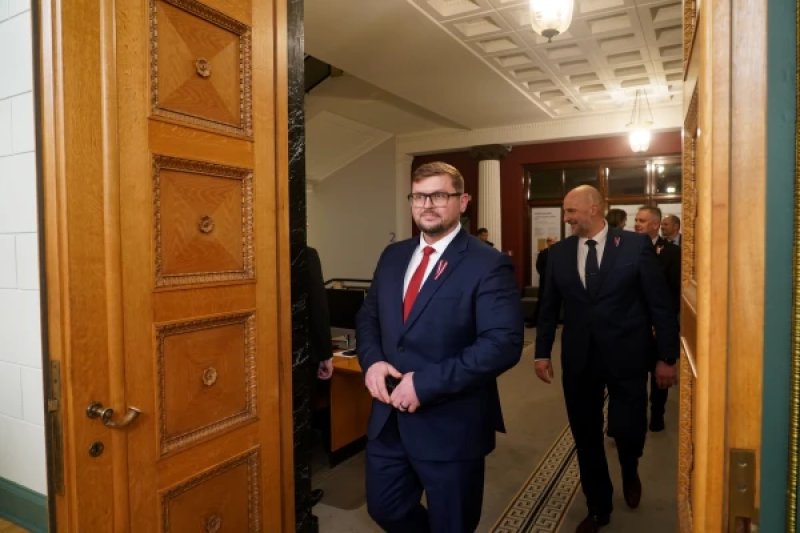
 Foto: BB.LV / Карлис Пургайлис
The money is planned to be obtained through a special Development Fund, to which shares of large state enterprises will be transferred. However, at the initial stage, the fund's debts will be counted as state debt, and servicing the loans may be more expensive than regular state borrowings, reports the TV3 program Nekā personīga. ### Main Text The government of Andris Kulbergs is preparing a large-scale restructuring of public finances. Over the next four years, the authorities plan to cut budget expenditures by two billion euros and find additional sources of income of another billion. At the same time, the state intends to attract up to two billion euros for investments in enterprises and promising sectors of the economy. At first glance, these plans contradict each other: on one hand, the government intends to save on public spending, while on the other, it is preparing to take new loans. However, the authorities hope that investments in the economy will help accelerate its growth and subsequently increase budget revenues. ### Where Will the State Save? The reduction in spending will affect the public administration system and the funding of public services. Among the measures being considered are the consolidation or liquidation of certain state institutions, a review of the network of hospitals and schools, as well as other ways to limit budget expenditures. The government hopes to reduce the costs of maintaining the state apparatus and redistribute existing resources. At the same time, measures to increase budget revenues are being discussed. Previously, among the possible solutions were freezing the planned increase in the non-taxable minimum and reducing expenses for sick leave payments. For residents, such changes may mean that the expected reduction in the tax burden on salaries will be postponed, and some social guarantees will be revised. At this point, specific decisions on individual measures still need to be made. So far, it is about the government's intentions, rather than all already approved changes. READ MORE >> [Everything is Fine, We're Going Down? The New Prime Minister and His Team Prepare Latvia for Cuts](https://bb.lv/statja/politika/2026/11/05/vse-xoroso-idem-ko-dnu-novyi-premer-i-ego-komanda-gotoviat-latviiu-k-sekvestru) ### Who Will Receive Tax Benefits? Against the backdrop of planned savings, the government is also proposing measures that should make Latvia more attractive to investors. In particular, a reduction in the capital gains tax rate from the current 25.5% to 17% is being considered. Additionally, significant investment projects are expected to receive tax incentives. Another initiative is a special fixed tax regime for wealthy foreigners, which, according to the authorities, should stimulate the inflow of capital into the country. Thus, the government is simultaneously considering limiting certain budget expenditures and providing tax advantages to specific categories of investors. ### State Enterprises Will Form the Basis of the New Fund A central element of Kulbergs' economic program is expected to be the Latvian Development Fund. It is planned to transfer state shares of seven enterprises, with a total value estimated at approximately 7.5 billion euros. Among them are the energy company Latvenergo, the state forest management enterprise Latvijas valsts meži, as well as telecommunications companies Tet and LMT. It is assumed that consolidating state assets in one structure will allow for more efficient capital management and attracting investments. The fund intends to issue bonds — debt securities, the buyers of which effectively provide borrowed funds at interest. This way, it is planned to attract up to two billion euros. The money is expected to be directed towards the development of the defense industry, the implementation of robotics, the construction and renovation of housing, as well as investments in enterprises. READ MORE >> [There’s Enough Money in Latvia. The Problem is Different... An Economist Reveals the Details of Kulbergs' Plan](https://bb.lv/statja/ekonomika/2026/11/12/v-latvii-deneg-xvataet-problema-v-drugom-ekonomist-raskryvaet-detali-plana-kulbergsa) ### Why Might New Loans Increase State Debt? One of the most significant questions relates to how the borrowings of the Development Fund will be reflected in state financial statistics. Finance Minister Karlis Purgailis acknowledged that at the initial stage, the fund's debts will be included in Latvia's state debt. In the future, the government hopes to ensure that they are accounted for separately. For this, the fund will need to meet the requirements of the European statistical office Eurostat. However, such a change will not happen automatically — it will depend on the legal and economic model of the fund's operations. There is also another problem: the new fund may attract funds at higher interest rates than the state does with direct bond issuance. This means that the cost of servicing the loans may be higher than with regular state borrowing. At the same time, the two billion attracted will not be free investment resources. Bonds imply obligations to pay interest and repay borrowed funds. Therefore, the economic outcome of the project will depend on how successful the financed investments turn out to be. ### A Balanced Budget by 2030 is Unlikely Another difficulty is the state of public finances. The finance minister admitted that it is unlikely that Latvia will be able to fully balance its budget by 2030. Instead, the government sets a more moderate goal — to keep the deficit within 3% of gross domestic product. Thus, even with the planned savings, public expenditures may continue to exceed revenues. At the same time, the creation of the fund does not eliminate the need to reduce the budget deficit. Moreover, if its loans are counted in state debt, they will increase the country's debt burden. ### Who Will Lead the New Fund? The creation of the Latvian Development Fund has been entrusted to Uldis Tatarčuks, who currently heads the board of the telecommunications company Tet. He is expected to be nominated for the position of Vice Prime Minister for Economic Development soon. Notably, the state share of Tet is also planned to be transferred to the newly created fund. In turn, Finance Minister Karlis Purgailis worked in investment management before joining the government. Such circumstances have raised questions about a potential conflict of interest, but both participants in the project deny such assumptions. "I see no conflict of interest here. On the contrary, it is a step towards the development of the industry," said Purgailis. READ MORE >> [LMT and Tet May Merge: Kulbergs Reveals the Plans of the New Government](https://bb.lv/statja/politika/2026/11/17/lmt-i-tet-mogut-obieedinit-kulbergs-raskryl-plany-novogo-pravitelstva) ### What Will Residents of Latvia Ultimately Gain? The new economic model of the government is based on two directions: reducing current expenditures and attracting borrowed funds for long-term investments. If successfully implemented, the fund's projects could contribute to the emergence of new enterprises, jobs, and additional tax revenues. However, these results remain expected for now, while budget constraints and loan obligations may arise significantly sooner. The main question is whether the state will be able to ensure sufficient returns on investments to justify the new debt obligations and help improve the state of the economy.
