

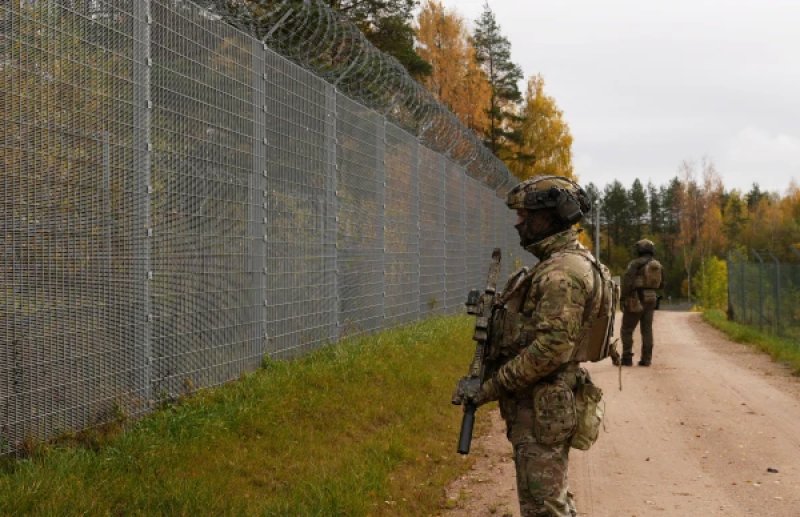
 Foto: BB.LV / граница
Latvia's Minister of the Interior Janis Dombrava (National Alliance) sent a letter to the European Commission demanding a change in the assessment of the migration situation in the country for 2027. As reported to the LETA agency by the Ministry of the Interior, Latvia insists on the recognition that it is facing significant migration pressure, rather than just the risk of it occurring. The difference is practically significant: the assessment of the situation determines the application of the European solidarity mechanism, which defines the distribution of responsibility for migration among EU states. ### "The Better We Secure the Border, the Less Pressure There Is" The main argument from the Latvian side is that the current methodology of the European Commission does not adequately take into account the work of border guards. According to Dombrava, Latvian services prevent attempts of illegal entry into the country through the external border of the EU on a daily basis. For this, the state is forced to allocate significant financial, technical, and human resources. However, the successful prevention of illegal entry leads to a paradoxical situation: since migrants do not actually enter the territory of the country, their attempts to cross the border are not reflected in the quantitative indicators of migration pressure. > "The better we secure the border and the more attempts of illegal entry we prevent, the less this pressure is reflected in the calculations of migration pressure," emphasized the minister. According to the Ministry of the Interior, this approach does not allow for an objective assessment of the burden on countries that protect the external borders of the European Union. This is not only about the costs of border protection. Latvia demands that the prolonged use of migration as a tool of pressure on the eastern border of the EU, as well as the burden on public services due to the reception of residents from Ukraine who left the country due to the war, be taken into account. READ MORE >> [Russia is Transitioning to a Prolonged War and Trying to Divide Europe — Latvia's Foreign Minister](https://bb.lv/statja/politika/2026/11/07/rossiia-perexodit-k-zatiaznoi-voine-i-pytaetsia-raskolot-evropu-glava-mid-latvii) ### Why is Latvia Displeased with Brussels' Decision? On November 6, the European Commission presented an assessment of the migration situation in EU countries for 2027. Latvia, along with Lithuania, Estonia, Poland, Finland, and several other states, was included in the group of countries at risk of migration pressure. However, the Ministry of the Interior believes that this status is insufficient, as it does not reflect the real burden on public services. The ministry points out that the situation at the border with Belarus has been ongoing for a long time, and preventing illegal crossings requires a constant presence and work of border guards. The Latvian side insists that these efforts must be taken into account when determining the country's obligations within the framework of the EU's migration policy. ### Accepting Migrants or Paying Money? One of the main reasons for the dispute is the solidarity mechanism provided for by the European Pact on Migration and Asylum. It stipulates that EU states participate in supporting countries experiencing significant migration pressure. Such support may include the resettlement of asylum seekers, financial contributions, or alternative measures, such as providing specialists, equipment, and technical assistance. Latvia seeks to avoid both the acceptance of migrants under this mechanism and additional monetary payments. > "Our position remains unchanged: we do not agree to the relocation of migrants to Latvia, nor to financial contributions. We offer what we do best — the experience of border guards, experts, and equipment," said Dombrava. At the same time, there is an important nuance. Alternative assistance is provided at the request of the state that is to receive it. If such assistance is not requested, there is a mechanism for converting it into a financial contribution. This is why the Ministry of the Interior is negotiating with Italy and other countries that need support from EU partners, striving for them to request Latvian specialists and technical resources. READ MORE >> [Latvia Obliged to Accept Refugees or Pay €20,000 for Each Unaccepted Migrant: Riga Does Not Give In](https://bb.lv/statja/politika/2025/12/22/latviiu-obiazali-prinimat-bezencev-ili-platit-po-20-tysiac-za-kazdogo-nepriniatogo-migranta-riga-ne-sdaetsia) ### The European Commission Promised to Change the Methodology, but Only from 2028 The Ministry of the Interior reported that after a joint appeal from the interior ministers of Latvia, Lithuania, Estonia, Poland, and Finland, the European Commission committed in writing to change its approach to assessing migration pressure. Starting from the assessment cycle for 2028, it is planned to quantitatively account for the prevented attempts of illegal crossing of the EU's external border. Until now, this data has not been included in quantitative calculations. Riga considers this an important result of the joint efforts of the five countries but insists that it is unfair to wait another year. > "Now we demand that the situation in Latvia be fairly assessed in this cycle, and not just in a year," emphasized Dombrava. ### Who Will Make the Final Decision? The question of contributions from states to the EU solidarity reserve for 2027 has not yet been definitively resolved. The corresponding decision is to be made by the Council of the European Union by a qualified majority of votes. This same body will decide on the possible reduction of contributions from individual states after the assessment by the European Commission. Thus, the appeal of the Latvian Ministry of the Interior is an attempt to achieve a revision of the country's status before the final commitments for 2027 are approved. It is still unknown whether the European Commission will agree to change the assessment now. However, Latvia intends to continue negotiations, striving for the costs of securing the external border and the possibility of providing assistance to other EU countries, primarily through specialists and equipment, to be taken into account.
