

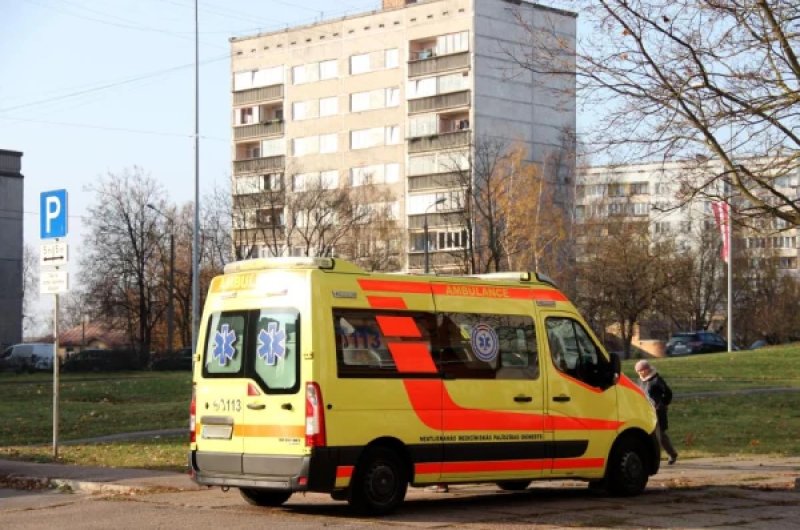
 Foto: BB.LV / Скорая помощь
This initiative was discussed on November 23 by Minister of Health Normunds Stanevics and Head of the Emergency Medical Service Liene Cipule, as reported by the Ministry of Health. ### **Who Should Receive Faster Emergency Response** As reported by the Head of the Communication Department of the Ministry of Health Oskars Schneider, the government plans to consider a draft amendment to the Cabinet of Ministers' rules regulating the provision of emergency medical care in the near future. The main innovation is the categorization of calls into three priority levels based on the severity of the patient's condition. For each category, specific response time standards for the teams are to be established. Thus, the procedure for dispatching emergency medical services will more clearly depend on the seriousness of the threat to a person's health. However, the specific criteria for categorizing calls and the standards for team arrival have not yet been provided in the ministry's announcement. ### **Hospitals Required to Accept Patients Faster** Another important change concerns the interaction between emergency medical services and hospitals. It is planned to establish a specific time frame within which the medical institution must accept a patient delivered by the NMPD team. Currently, one of the issues remains the time that emergency medical staff must spend in hospitals waiting to transfer the patient to medical personnel. The new rules are expected to reduce such delays and allow teams to return to responding to subsequent calls more quickly. The changes will also affect the transportation of patients between medical institutions. It is anticipated that hospitals will be required to prepare the patient for transport even before the arrival of the emergency medical team. This will help reduce the time that vehicles and medical personnel are idled, as well as improve the overall efficiency of the service. ### **Ambulance Fleet Needs Updating** During a meeting with the minister, the head of the NMPD Liene Cipule emphasized the need to update the service's vehicle fleet. According to her, this is one of the priority issues that affects the ability to continuously and effectively provide emergency medical care to residents in all regions of Latvia. The parties also discussed the availability of emergency medical services, the effectiveness of response to calls, staff motivation, technical equipment, and future directions for the service's development. A separate topic was the impact of budget cuts on the operation of the NMPD. This concerns the consequences of the review of state expenditures initiated by the previous government in 2025, as well as measures to improve the efficiency of resource use in the public sector. ### **Minister Promises Equal Access to Care** Normunds Stanevics emphasized that the main priority remains timely and equally accessible emergency medical care for all residents of Latvia. The minister praised the selfless work of NMPD staff, who have to perform their duties under high pressure. He also expressed confidence that the decisions made by the service's management regarding the optimization of operations and resource planning are made after careful assessment and are based on objective data. The Ministry of Health intends to continue cooperating with the NMPD in planning the development of the service and the necessary financial and technical resources. The goal is for residents of Latvia to receive timely emergency medical care regardless of their place of residence. ### **What Other Changes Are Planned in Healthcare** In the first days after taking office, Normunds Stanevics also met with employees of the Ministry of Health and heads of subordinate institutions. At the meetings, the main directions for further work, principles of cooperation, and common tasks for the sector were discussed. The minister emphasized that the development of the healthcare system should be based on the goals outlined in the government's declaration. The main focus is expected to be on solutions that improve the accessibility of medical care, its quality, and the patient experience when seeking medical services. > "Our common goal is a healthcare system where the needs of the patient are at the center of decision-making," noted Stanevics. According to him, achieving this goal requires close cooperation, mutual trust, professional discussion of issues, and clear distribution of responsibilities. > "It is important to me that our work is based on facts, openness, and respect for the professional competence of each," stated the minister. ### **Waiting Times for Doctors, Hospitals, and Drug Prices** According to the declaration of the government of Andris Kulbergs ("United List"), large-scale transformations are planned in healthcare. One of the key areas will be a complete reform of the quota system for medical services. It is planned to introduce a unified patient registration system and reduce waiting times for appointments with specialists and for examinations. The government also intends to review the network of hospitals to ensure quality and accessible medical care. Another planned change is the transformation of the National Health Service into the National Health and Care Insurance Fund. The new structure is to become a single purchaser of medical services and care services funded by the state. Among other priorities is strengthening primary medical care and disease prevention. The government also intends to stimulate competition in the pharmaceutical market to achieve lower drug prices. ### **Special Attention to Children and Chronically Ill Patients** Separate changes are planned in the medical care system for children. It is planned to create an integrated healthcare system that will ensure access to necessary medical services for minors. At the same time, the government intends to abolish quotas for such services, taking into account the capabilities of the state budget. Another direction will be to expand access to mental health care. Special attention is expected to be given to children, youth, and the elderly. In addition, the government plans to improve the procedure for forming stocks of critically important medicines and their supply. It is also planned to expand access to medications and improve the system of reimbursement for the cost of drugs for patients with chronic and rare diseases. Thus, changing the emergency response procedures will be one component of a broader healthcare reform. However, the new rules for categorizing calls into three categories still need to be reviewed by the government.
