

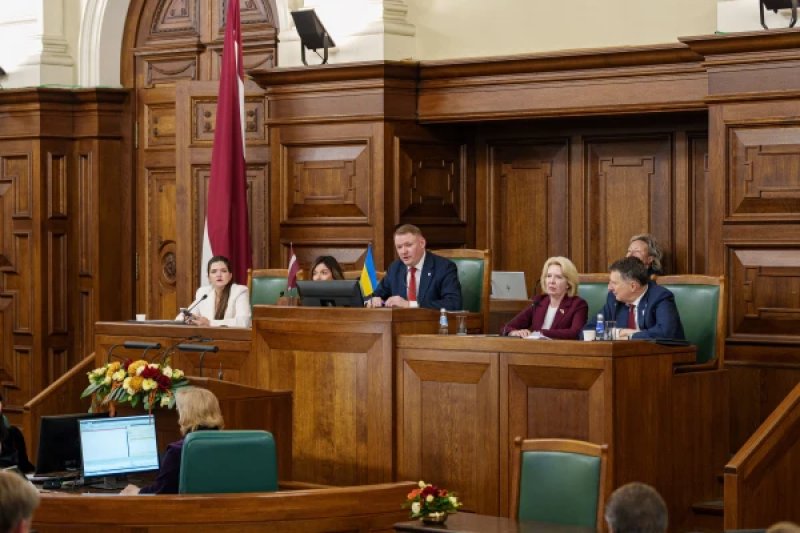
 Foto: BB.LV / Сейм
## Dividing Posts Namely: 5 members of the presidium (the Speaker of the Saeima, two vice-speakers, the secretary, and the deputy secretary of the presidium), the chair, deputy, and secretary in each of the 16 committees, as well as in each of the 6 parliamentary factions — the chair and their deputy. As is known, the presidium was elected on the very first day of the new parliament's work, and the factions have already determined their leaders. And now the leadership in the committees has also been elected. It is still unclear whether subcommittees will be created in this Saeima, but additional payments are provided for the positions of chair and secretary in these committees. As for the committees, the most posts of committee chairs, which is logical, will be held by the United List — 10! The National Alliance will "lead" three committees, and one committee has been "allocated" to the opposition factions — "Latvia First," "Progressives," and "New Unity." Another opposition faction, "Sovereign Power - Young Latvians," has been left without positions in the committees. It is worth noting that former Prime Minister Evika Silina will head the Committee on Long-Term Development and Demography. However, the Speaker of the Saeima, Edvards Smiltens, shortly after his election to this post, expressed support for reducing the number of committees, and named the committee that Silina will now lead as the first one for possible liquidation. For work in two committees of the parliament — on national security and on defense and internal affairs — deputies will need to gain access to state secrets. If any deputies do not receive such clearance, they will not be able to work in these committees. The first regular plenary session will take place the day after tomorrow, at which it is planned to transfer to the committees those draft laws that have come from the Cabinet of Ministers. The Saeima opposition has already decided from the very beginning to show that... it does not intend to doze off. ## The Opposition is Not Sleeping! Thus, in particular, **"New Unity"** demanded from the Prime Minister a schedule for the government’s adoption and submission to the Saeima of the budget project for 2027 and subsequent years. In turn, the deputies of **"Sovereign Power - Young Latvians"** want to know from the Prime Minister what is meant by item 118 of the government declaration, which speaks of the intention to adopt a Declaration on Derussification with a call to limit the use of the Russian language in public space. How exactly do the politicians intend to limit the Russian language in public space? So far, it is only known that, according to the Minister of Culture Nauris Puntulis (National Alliance), there will need to be a refusal of any communication in the state language by state institutions. Frankly, this is a strange passage, as state institutions have not communicated in Russian for at least the last 4 years. Or is this a hint at the impending closure of the M. Chekhov State Theatre? Let us recall that in early June last year, a week before the municipal elections, the National Alliance submitted this Declaration on Overcoming the Consequences of Russification to the previous Saeima. It was even sent to the education committee, where it has remained until now. Deputies from another currently opposition faction, **"Progressives"**, have submitted amendments to two laws — on immigration and on railways. The "Progressives" want to legally prohibit the transit of Russian grain through Latvia, as well as repeal the article of the law that allows attracting investments from citizens of third countries in exchange for residence permits. The "Progressives" want to prohibit both the transportation of grain with a specified final destination in the Russian Federation and the Republic of Belarus, as well as the transportation of Russian and Belarusian grain through Latvia for export to other countries. It is worth noting that until recently, it was representatives of the "Progressives" — Brishkens and Shvinka — who led the Ministry of Transport, but for some reason, they did not come forward with such initiatives. As for the amendments regarding residence permits, the "Progressives" do not consider it possible to "trade golden visas" to attract wealthy foreigners. We dare to assume that the Saeima majority will reject both of these draft laws. It seems that in the near future, the new Saeima will decide which of the draft laws not adopted by the previous convocation will be taken up for further consideration.
