

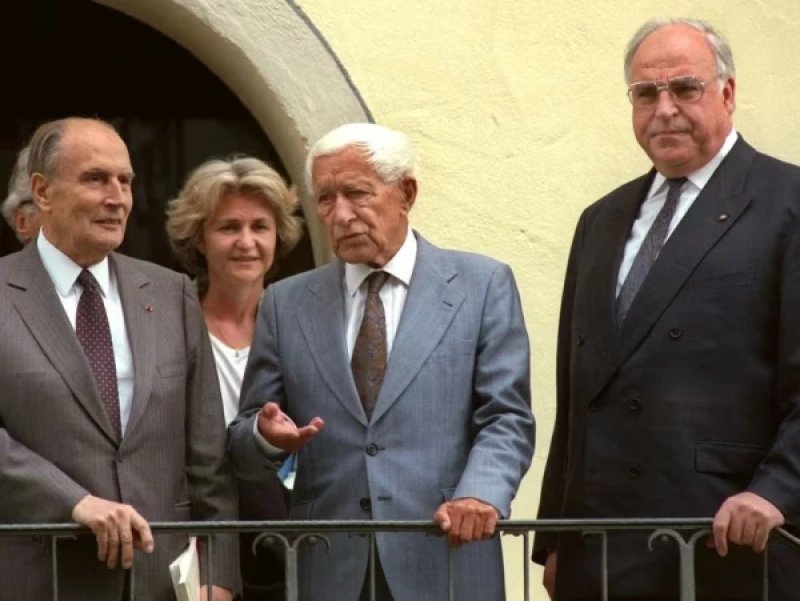
 Foto: BB.LV / Франсуа Миттеран, Эрнст Юнгер и Гельмут Коль
The secret to a long and fulfilling life, according to Jünger, lay not in strict diets or miraculous remedies, but in constant intellectual activity and the ability to marvel at the new. Today, many people are trying to find a universal recipe for longevity. Some adhere to strict dietary restrictions, others engage in physical exercise, while others spend large sums on various supplements and procedures. However, as the Hungarian publication [Dívány](https://divany.hu/?utm_source=chatgpt.com) reminds us, citing the Spanish newspaper El País, one of the outstanding European writers of the 20th century took a completely different approach. ### **After 70, Life Only Gained Momentum** Ernst Jünger was born in 1895, survived two world wars, and witnessed almost all the major events of the 20th century. He died on February 17, 1998, at the age of 102. Despite his advanced age, he did not give up his favorite activities. In his diaries, the writer described the last three decades of his life as an exceptionally fruitful and creatively rich period. Unlike many people who gradually narrow their interests with age, Jünger continued to discover new fields of knowledge. He believed that one of the most important prerequisites for active longevity is having a passion that accompanies a person throughout their life. It is especially beneficial if the beloved activity is also a profession. ### **Insects Helped Maintain Mental Sharpness** For Jünger, this passion became entomology—the study of insects. Even after 70, the writer continued to go on expeditions, study nature, collect beetles, classify them, and research the characteristics of various species. He did not limit himself to walks in the fresh air. A significant portion of Jünger’s time was devoted to meticulous scientific work, including studying insects under a microscope. In his belief, even observing the tiniest beetle can bring a person closer to understanding the structure of the universe. Such activities required attention, observation, good memory, and constant acquisition of new information. Jünger was convinced that it is continuous intellectual work that helps maintain clarity of thought. ### **The Main Thing is Not to Stop Being Amazed** Another important principle for the writer was openness to new knowledge. Jünger noticed that with age, many people begin to cling more tightly to their familiar beliefs, reject unfamiliar ideas, and gradually lose interest in change. He himself tried to avoid such an attitude toward life. Until his last years, the writer kept famous diaries, continued his literary activities, welcomed young colleagues, and took an interest in scientific discoveries. He also paid attention to technological progress, even though many innovations appeared when he was well into his nineties. Jünger believed that true spiritual old age does not come with the appearance of wrinkles and physical weakness, but when a person stops sincerely marveling at the surrounding world. According to him, it is curiosity that sustains inner energy and the desire to live. ### **A Passion That Outlived the Writer** Jünger’s scientific pursuits left a mark in entomology. Several species of beetles, including those inhabiting subtropical regions, were named in honor of the writer. Thus, his name has been preserved not only in literature but also in scientific catalogs. Jünger remained a person for whom exploring the world was an inexhaustible source of inspiration until the end of his life. His example shows that retirement does not necessarily mean giving up active pursuits. On the contrary, free time can be used for learning languages, reading, creativity, traveling, acquiring new skills, or deepening long-standing hobbies. ### **Can Curiosity Extend Life?** Of course, the story of one centenarian does not prove that constant intellectual activity alone allows one to live more than a hundred years. Longevity depends on many factors, including genetics, health status, nutrition, physical activity, and living conditions. However, maintaining social connections, mental activity, and interest in the surrounding world is considered an important component of healthy aging. The story of Ernst Jünger reminds us of a simple principle: no matter how old a person is, there is always an opportunity to learn something new. And perhaps it is the desire to discover something interesting every morning that helps maintain a sense of fullness of life even at the most venerable age.
