

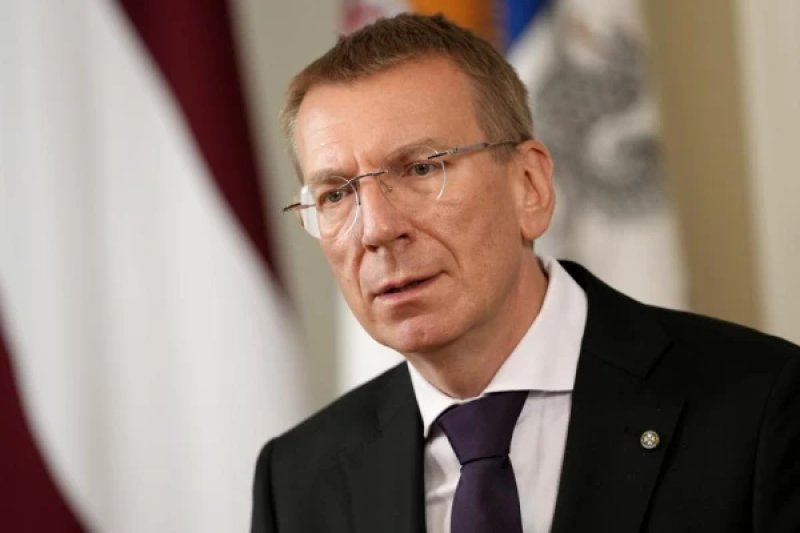
 Foto: BB.LV / Эдгар Ринкевич
The head of the Latvian state stated this in an interview with Reuters during his visit to New York, as reported by bb.lv. ### The Turning Point May Come in Spring or Summer Rinkēvičs expressed doubt that Moscow is genuinely interested in ending the war. In his opinion, the Russian authorities are likely using negotiations for a ceasefire as a cover to continue military actions. The President of Latvia acknowledged that Ukraine is going through an extremely difficult period. A harsh winter lies ahead, the Russian army is intensifying strikes on energy infrastructure, and attacks on civilian objects are becoming increasingly intense. Rinkēvičs referred to this combination of circumstances as a "perfect storm." At the same time, he emphasized that Ukraine has repeatedly demonstrated its ability to withstand severe trials, and European countries are ready to continue military and financial support for Kyiv. "If we see that Ukraine is surviving both militarily and economically, and I am confident that Ukraine will survive, then the turning point may come next year — in spring or summer," said the President of Latvia. According to him, pressure on the Russian economy is increasing, and the number of states advocating for an end to the war is growing. Rinkēvičs believes that the combination of economic difficulties and international political pressure could significantly change the situation in the coming months. ### Russia is Becoming Increasingly Audacious The President paid special attention to the hybrid threats posed by Russia to European states. This includes violations of airspace, cyberattacks, sabotage, arson, and attacks on organizations supporting Ukraine. According to Rinkēvičs, the number of such incidents has noticeably increased since 2022. At the same time, Moscow, as the Latvian president believes, is currently trying not to cross the line that could lead to the application of Article 5 of the North Atlantic Treaty, which provides for the collective defense of allies. > "So far, Russia has tried not to cross the red line that would lead to the application of NATO's Article 5 and force member states to assist each other. However, it is becoming increasingly audacious," noted Rinkēvičs. The President emphasized that the Russian leadership is acting cautiously, trying to avoid direct military confrontation with NATO, but at the same time is showing an increasing willingness to take risks. ### Europe is Seeking Ways to Respond to Provocations Rinkēvičs mentioned recent hybrid incidents in Germany, Spain, and the Baltic states. According to him, such actions create a complex task for European governments: they need to find a proportional response without allowing further escalation. At the same time, cooperation among European intelligence and counterintelligence services is becoming closer. Countries are actively exchanging information, coordinating actions, and in some cases managing to prevent planned attacks. The President also reported that on Monday, Latvia once again summoned the Russian ambassador in connection with recent attacks by Russia, emphasizing the importance of publicly condemning such actions diplomatically. According to Rinkēvičs, European states are responding to Moscow's provocations by expanding cooperation, exchanging intelligence information, and mutual support. However, he warned that the confrontation remains ongoing. "The problem is that you always face a very skilled opponent who also uses new ways to test you and attempt to attack. And this is a constant struggle," concluded the President of Latvia.
