

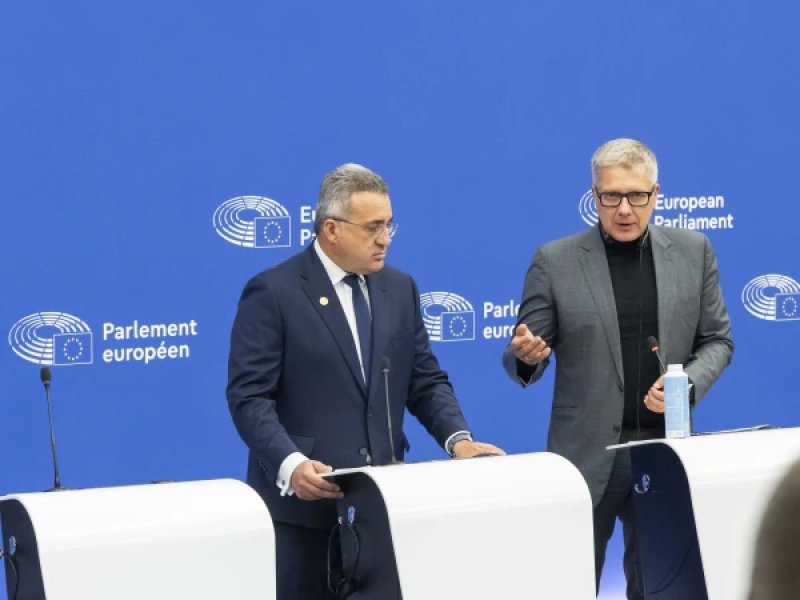
 Foto: BB.LV / На пресс-конференции в Страсбурге Ушаков сравнил бюджет ЕС со «стереотипным восточноевропейским».
## What Does This Mean for Latvia? The final round of negotiations on the European Union budget for 2027 concluded on November 11 at around 6:40 AM, right on Lāčplēsis Day. This agreement is particularly important for Latvia at this time. Within the country, a plan for strict austerity is being discussed: state expenditures are set to be reduced by three billion euros over four years, with approximately 800 million to be cut already next year. There is still no clarity on whether the Saeima will approve the national budget this year. "I do not want to idealize the European Union," emphasizes Nils Ušakovs. "And I have many questions about how effectively EU funds are spent in Latvia. But at the same time, we must adhere to common sense — the EU budget, in one form or another, is an extremely important support for every resident of Latvia. EU money means school repairs and park construction, roads and hospitals, home insulation, support for farmers, programs for students and science." ## Where the Additional Millions Will Go What lies behind the lines of the European budget for ordinary families, Ušakovs explained at a plenary session in Strasbourg with one simple question: "Can a student from Daugavpils or Valencia afford a semester abroad without relying on their parents' savings?" As a result of the Brussels compromise, an additional 14 million euros has been allocated for the Erasmus+ student exchange program. Additional funds are also earmarked for other European programs that are in demand in Latvia. For scientific research under the Horizon Europe program, an additional 21.5 million euros will be directed, and for the development of transport and energy networks under the CEF program, another 22.5 million is provided. The European Civil Protection Mechanism will receive an additional 13.5 million euros, and funding for the European Public Prosecutor's Office has been increased by 2 million. A separate decision has been made regarding an institution operating right in our capital: an additional 0.5 million euros has been allocated to the Riga office of the BEREC telecommunications agency — the only EU structure headquartered in Latvia.  _The clock on the wall shows 6:42 AM — the negotiations have just concluded. Nils Ušakovs shakes hands with the Irish Deputy Prime Minister and Minister of Finance Simon Harris, who led the negotiations on behalf of the EU member states._ ## The Arithmetic of the Night Compromise The final agreement is led by the EU Council, which represents the governments of all 27 EU countries, and the European Parliament. The meeting takes place in the Brussels building of the EU Council. This semester, Ireland is chairing the Council, and the negotiations on behalf of the EU member states were led by Irish Deputy Prime Minister and Minister of Finance Simon Harris. From the European Parliament, a delegation of 27 deputies participates on an equal footing. The annual budget must be approved by both sides, and if one of them is against, there is no budget. The dispute over the 2027 budget has been centered on one issue — money. In June, the European Commission, which is the executive body of the EU, submitted the initial draft. The EU Council proposed to cut 1 billion euros from it, while the European Parliament called for restoring that billion and adding another 1.17 billion on top. The final round of negotiations started on the morning of November 10 at nine o'clock and lasted almost a full day without a break. Immediately after the morning exit from the Council building, the deputies were to return to the plenary session. It seems that this time patience decided the outcome: the budget reduced by 1 billion euros was restored to its original size and an additional 0.3 billion euros was added. The total agreed EU budget for the next year amounted to 199.7 billion euros in commitments and 211.5 billion euros in payments. Given the current circumstances, this is a respectable result.  _Around four in the morning, approximately on the 19th hour of negotiations with the EU Council. Nils Ušakovs with colleagues._ ## Budget Below One Percent The negotiations stretched until 6:40 AM — according to Ušakovs, this is a record. He also stated that this year he received the most "sad" annual budget in the recent history of the Union. When the current seven-year plan was approved in December 2020, the calculation was based on an average level of no less than 1.11% of gross national income, that is, the total income of the economies of the Union countries. However, by 2027, the threshold has dropped to 0.99%. This figure has fallen below the psychological barrier of 1.00%, which has historically been called for by the most "stingy" donor countries. Thus, the agreed document turned out to be more modest than the requests of the most frugal European capitals. "At the beginning of the year, I certainly understood that the budget would be difficult, but I did not expect it to be of this magnitude," Ušakovs recounts after the night negotiations. "We started the year with the expectation of additional money. Then the war in Iran began, and the internal political situation in France and Germany sharply deteriorated, where anti-European forces are currently leading in the polls. As a result, we are ending the year with updated goals — at least to avoid cuts in programs." ## Dispute Over the Seven-Year Plan An even harsher clash of interests is unfolding in Brussels over the next seven-year EU budget for 2028–2034. In 2020, budget gaps were closed with a common anti-COVID credit. Now the time has come to repay it, and there are no extra resources left in the European treasury. When in October the presiding Ireland proposed to cut the European Commission's initial draft by more than 140 billion euros, a rare consensus emerged in the negotiations: everyone was dissatisfied. The six wealthiest donor countries, led by Germany and the Netherlands, deemed such a step insufficient and are demanding further cuts to the plan by several hundred billion euros. Eastern and Southern European countries argue that there is already too little funding. Poland and Lithuania opposed cuts to defense and security spending. The October summit of EU leaders lasted fourteen hours, but no agreement was reached. It may not be possible to approve the new multiannual plan by the end of this year. Tensions are also heightened by next year's elections in several Union countries, primarily in France: Marine Le Pen has already promised that if elected president, she will radically reduce Paris's contribution to the common treasury. ## The Council Delays Decision on the Border A separate topic of the night round was targeted assistance for the eastern border of the European Union. At Ušakovs' initiative, the majority of the Members of the European Parliament supported a decision to recognize the eastern flank as one of the budget priorities. However, national governments in the EU Council categorically refused to launch a separate support program for the border. Their position did not change even after negotiations that lasted until nearly seven in the morning. Representatives of the governments seem willing to return to discussions about separate funds for the eastern borders only within the framework of the new seven-year budget. This is what Latvia and other countries in our region are currently fighting for — the allocation of an additional 7 billion euros for the eastern flank of the EU in the new budget. The autumn work on the 2027 budget provided the governments of Latvia and other Baltic and Eastern European countries with an argument: the majority of the European Parliament has already voted to make the eastern flank one of the priorities. And, of course, the budget managed to maintain funding for programs that are already extremely important for the border area, and in some cases — for example, for strengthening the external border — even slightly increase it. ## Nine Billion and Clear Priorities According to current estimates, the seven-year EU budget for 2028–2034 may provide around 9 billion euros for Latvia. "European money will be there, and that is quite a lot. But the attitude towards European money will definitely have to be reconsidered," emphasizes Nils Ušakovs. "We cannot afford to leave something unused. We cannot afford to spend just for the sake of spending. We will have to define clear, understandable priorities — and stick to them."  _Nils Ušakovs and Apple CEO Tim Cook at a company event._ ## Artificial Intelligence in the Budget Committee Nils Ušakovs is an economist by education, specializing in analytical economics. In recent years, alongside politics and work in the European Parliament, he has been systematically engaging in self-education — studying artificial intelligence and its implementation practices, including in public administration. "If artificial intelligence is used correctly, it can make public administration more honest, efficient, and transparent. And most importantly — it can significantly improve the accountability of politics and public administration to ordinary citizens," Nils Ušakovs explains. Alongside his work on the budget, Ušakovs has authored a project to implement artificial intelligence directly into the activities of the European Parliament's Budget Committee. Throughout this year, a joint team from two directorates-general of the European Parliament — the budget and IT departments of the parliamentary administration — has been creating the system. Development is ongoing, and it is planned that next year the system will begin to be tested in practice. The system has strict security and accuracy requirements. It is hosted on the European Parliament's own servers without using external cloud services, relies on open and European models, and works with non-confidential data, with each response accompanied by a direct link to the primary source. "It is very important to note: my goal is not to fire specialists. The task is to relieve them of technical work and leave more time for content," Ušakovs says. "I hoped that we would manage to work with this system on this budget, but it did not happen."  According to Ušakovs, this will likely be the first case of applying artificial intelligence in the legislative work of the European Parliament, not just for translations or preparing briefs. Another important goal of the project is transparency, so that every resident of the European Union can see how common funds are spent. In the next phase, the system could be opened to the public and journalists, not just to deputies and staff of the EP. Currently, there are hundreds of amendments and complex documents in the budget procedure, which are difficult to navigate without preparation, and the new tool will allow questions about EU finances to be asked in simple language and receive understandable answers. With the help of AI, it will be possible to track the entire budget path and its dynamics over the years — from the initial draft to the final vote, seeing where funds are lacking and where they remain unused. Anyone interested will also be able to find all submitted amendments and see how they progressed. "Artificial intelligence is good. But when you need to wear down representatives of 27 governments until seven in the morning, it won’t help," Ušakovs adds.  Prepared with the support of the Progressive Alliance of Socialists and Democrats in the European Parliament. Information about Member of the European Parliament Nils Ušakovs and how to contact him: www.socialistsanddemocrats.eu/meps/usakovs-nils
