

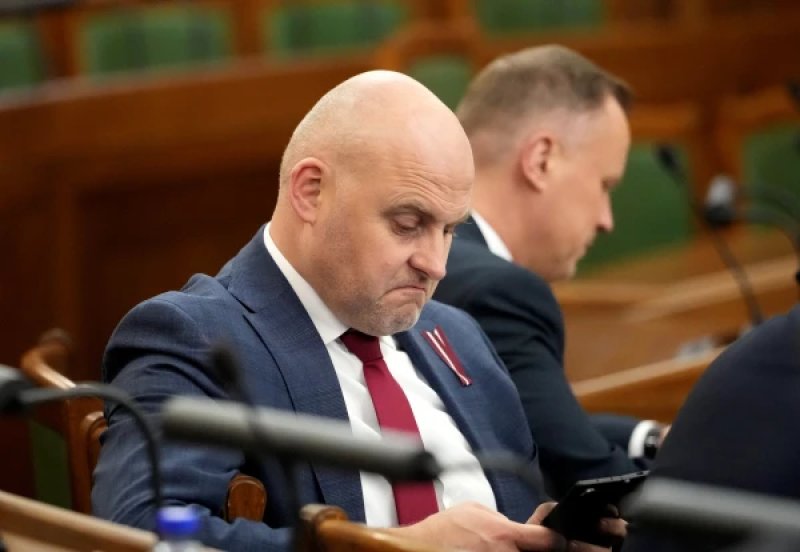
 Foto: BB.LV / Андрис Кулбергс
Latvia is negotiating with Ukraine about using its transport infrastructure for the export of Ukrainian grain. Important news about the results of this work may emerge soon. This was stated by Prime Minister Andris Kulbergs (United List) on Wednesday, November 25, in an interview with TV3. According to the head of government, the Latvian side, together with Ukrainian partners, is looking for solutions that will allow Ukrainian grain to be directed through Latvia to international markets. Kulbergs promised 'big news,' but did not specify what agreements are being prepared, what volumes of cargo are expected to be transported, and when supplies might begin. Thus, for now, it is a political statement rather than an announced agreement with specific deadlines and volumes of transportation. ### Why is Russian Grain Still Coming Through Latvia? At the same time as searching for opportunities for Ukrainian exports, the government continues to discuss a ban on the transit of grain from Russia. Despite repeated promises to consider this issue, a final decision has not yet been made. Kulbergs explained that this week the Cabinet of Ministers did not have time to return to the topic of Russian grain, as the main focus was on preparing questions related to the financial situation of the airline airBaltic. In response to journalists' remarks that assistance to Ukraine does not exclude the possibility of banning Russian transit, the Prime Minister said that the situation is significantly more complicated. According to him, the government needs to consider not only political but also economic, legal, and logistical consequences of a possible ban. > "We cannot take hasty steps," Kulbergs stated. The Prime Minister claims that unilateral restrictions could affect the interests of foreign partners, including companies from Asia and the USA, whose cargoes are already en route. READ MORE >> [Ban or Allow: Residents of Latvia Divided on Russian Grain](https://bb.lv/statja/ekonomika/2026/11/20/zapretit-nelzia-razresit-ziteli-latvii-razdelilis-vo-mneniiax-o-rossiiskom-zerne) ### Estonia Closes the Border. Why is Kulbergs Against? Another topic of the interview was Estonia's decision to close road border crossings with Russia starting December 1. Kulbergs called this step a mistake and linked it to the pre-election atmosphere in the neighboring country. In the opinion of the Latvian Prime Minister, the closure of the border by one Baltic country without similar decisions from the other states in the region will not yield the expected result. He considers it reckless to take such a step if Latvia and Lithuania do not do so at the same time. However, Estonia's decision has already been made: starting December 1, the country will cease road communication through border crossings with Russia. At the same time, the restrictions do not mean a complete cessation of railway cargo transportation. The Estonian authorities explained their decision by national security considerations and the need to reduce risks associated with Russia's actions. In particular, Tallinn links the tightening of border controls to the threat of sabotage and the activities of Russian special services. Thus, the assessments of the two neighboring governments differ significantly. Estonia emphasizes security, while the Latvian Prime Minister warns of the economic and logistical consequences of unilateral border closure. ### What Will Happen to the Flow of Cargo and Vehicles? In Riga, preparations are already underway for a possible increase in traffic flow at the Latvian-Russian border after the closure of the Estonian border points. Some drivers and carriers who previously used Estonian routes may attempt to cross the border through Latvia. This creates a risk of additional strain on border services and increased queues. Kulbergs reported that the Latvian side is considering four possible scenarios for further actions. However, the content of these scenarios was not disclosed by the Prime Minister. Earlier, he instructed the responsible ministries to assess the consequences of the Estonian decision and prepare proposals for possible actions by Latvia. A final decision on the closure of Latvian road border points with Russia has not yet been made. READ MORE >> [The Government May Decide on Countermeasures to Estonia's Border Closures](https://bb.lv/statja/politika/2026/11/23/pravitelstvo-mozet-priniat-resenie-ob-otvetnyx-merax-na-zakrytie-pogranicnyx-punktov-estonii) ### The Ban on Russian Grain Has Been Discussed for Over a Month The issue of the transit of Russian grain remains one of the contentious points in Latvian politics. On November 13, the Ministry of Foreign Affairs, then headed by Baiba Braže, announced the preparation of a national sanctions project against the transit of grain of Russian and Belarusian origin through Latvia. The relevant proposals were submitted to the Prime Minister. However, Kulbergs demanded additional verification of the information, including involving security services, and an assessment of possible consequences. The Prime Minister is also consulting on this issue with the President of Latvia, Edgars Rinkēvičs. According to Kulbergs, an emotional decision to impose a ban could be made immediately, but the government must consider the long-term interests of the state and the possibility of helping Ukraine. He asserts that Latvia is not interested in the transit of Russian grain, but a hasty decision could simultaneously limit opportunities for transporting Ukrainian products. The Prime Minister hopes that the necessary materials can be gathered by next week, after which the Cabinet of Ministers will reconsider the issue. ### Meanwhile, Volumes of Russian Transit Have Tripled While the government discusses restrictions, Russian grain continues to be transported through Latvian territory. According to the State Revenue Service, in the first ten months of 2026, approximately 1.115 million tons of grain crops from Russia were transported through Latvia. This is 3.1 times more than during the same period in 2025, when the volume was about 358 thousand tons. At the same time, Latvia is already restricting the import of Russian agricultural products for the domestic market, but a ban on its import and a ban on transit through the country are different measures. The issue of transit remains unresolved. On one hand, the government promises to find new ways to support Ukrainian grain exports. On the other hand, it is not yet ready to completely cut off Russian cargo flows. The main question now is whether Kulbergs will propose a specific mechanism that will actually allow for an increase in the transportation of Ukrainian grain, and whether the government can simultaneously decide to halt Russian transit.
