

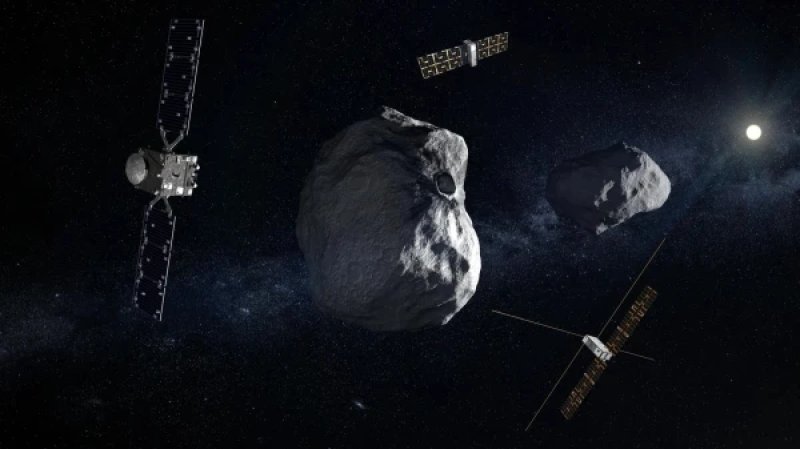
 Foto: BB.LV / Hera
## One impact changed not only the asteroid's orbit On September 26, 2022, the American spacecraft DART intentionally collided with a small asteroid Dimorphos, which has a diameter of only 151 meters. This celestial body orbits a larger asteroid Didymos, which has a diameter of about 730 meters. Together, they move around the Sun and are currently located 193.5 million kilometers from Earth. NASA's experiment had a very specific goal — to determine whether the motion of an asteroid could be altered by a collision with a spacecraft. The result exceeded expectations: the orbital period of Dimorphos around Didymos was reduced by 33 minutes. However, Earth-based telescopes allowed for measuring the change in orbit but did not provide a detailed view of the damage to the asteroid itself. Now, the European mission Hera has reached the collision site and has begun transmitting images. READ MORE >> [Humanity changed the orbit of this asteroid: the European probe saw the consequences of the NASA experiment from afar for the first time](https://bb.lv/statja/tehno/2026/11/04/celovecestvo-izmenilo-orbitu-etogo-asteroida-evropeiskii-zond-vpervye-uvidel-posledstviia-eksperimenta-nasa-izdaleka) ## The crater occupies almost the entire side of the celestial body Before obtaining new photographs, scientists considered several possible scenarios. Some suggested that a crater had formed on the asteroid, others expected a change in its overall shape, while others assumed that it had not changed much externally. Surprisingly, all three hypotheses were partially confirmed. On the side of Dimorphos that was impacted, a crater the size of a sports stadium formed. It stretches across the entire width of the asteroid, giving one side a flattened shape. Meanwhile, the other areas of the surface appear almost the same as in the photographs taken in 2022. Even the positioning of many boulders remains unchanged. However, the consequences of the collision were noticeable not only on the surface. According to Michael Küppers, a scientist on the Hera mission, after the impact, the asteroid began to rotate chaotically while moving in its orbit around Didymos.  ## Hundreds of unknown objects discovered around the asteroids Another surprise for researchers was the discovery of hundreds of boulders several meters in size, moving around the double asteroid system. They were detected thanks to long-exposure imaging. Now, engineers will have to take the presence of these objects into account when planning further approaches of Hera to the asteroids. The European spacecraft, about the size of a small car, is currently approximately 25–30 kilometers away from them. Due to the extremely weak gravity of the celestial bodies, it must regularly use its engines to adjust its trajectory. The average speed of the spacecraft relative to the asteroids is only 12 centimeters per second — significantly slower than a human step. ## Why does humanity need to know how badly the asteroid was damaged? The first detailed images of Dimorphos were presented in a symbolic location — the dinosaur hall of the Berlin Natural History Museum. It was the collision with an asteroid about 66 million years ago that caused the mass extinction that led to the disappearance of non-avian dinosaurs. Now humanity has received experimental confirmation for the first time that it is capable of deliberately altering the motion of an asteroid. At the same time, neither Dimorphos nor Didymos posed a threat to Earth. They were chosen to test a technology that may be useful in the future for detecting truly dangerous celestial bodies. The mere fact of successfully deflecting an asteroid is not enough to create a reliable planetary defense system. Scientists need to understand how the impact result depends on the size, mass, composition, and internal structure of the celestial body. This will affect the accuracy of calculations when conducting similar operations in the future. This is the task that the European mission Hera must solve. ## Two more spacecraft will head to the asteroids in January The obtained photographs are just the beginning of a large-scale study. In December, Hera is expected to approach the asteroids to within about 13 kilometers, allowing for higher resolution surface images. In January 2027, two miniature satellites the size of a shoebox are planned to be launched. The first, Juventas, developed under the guidance of Luxembourg, will attempt for the first time to investigate the internal structure of the asteroid using low-frequency radar. Subsequently, it aims to attempt a landing on Dimorphos. The second, Milani, created under the guidance of Italy, will study the composition of the surfaces of the asteroids and the dust surrounding them. Together, the three spacecraft will allow scientists to obtain a significantly more complete picture of the consequences of the collision. The development of Hera and its satellites involved companies from 18 member states of the European Space Agency. ## The next target is the famous asteroid Apophis The European Space Agency, in collaboration with the Japanese agency JAXA, is already preparing the next mission in the field of planetary defense — Ramses. Its target will be the asteroid Apophis, which will pass approximately 32,000 kilometers above the Earth's surface on Friday, April 13, 2029. This is closer than geostationary satellites. A collision with our planet is excluded, but such a close approach presents enormous scientific interest. Earth's gravity may affect the asteroid's rotation, the state of its surface, and even its internal structure. The Ramses spacecraft will monitor these changes. If the Hera mission helps understand how an asteroid reacts to an artificial impact, then Ramses will allow studying the consequences of the planet's natural gravitational influence. The results of both missions should bring scientists closer to creating a technology that, in the event of a real space threat, will not only detect a dangerous asteroid but also alter its trajectory.
