

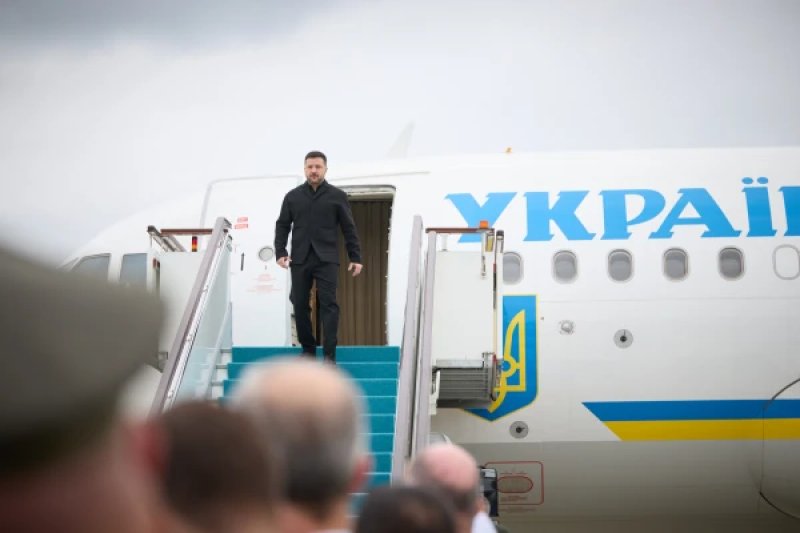
 Foto: BB.LV / Зеленский на трапе самолета
These results come from a survey conducted this week by the non-profit Körber Stiftung. The share of those supporting aid to Kyiv has dropped to 46% - down from 59% a year ago. These results fit into the overall trend of recent years, as war fatigue continues to grow. And the war, let us remind you, is approaching its fifth anniversary since Kremlin dictator Vladimir Putin launched a full-scale invasion, writes Politico. For centrist leaders in Europe, who are already facing budget shortfalls and rising support for populist skeptics regarding Ukraine, the political risk is now very serious. But many politicians continue to insist on their stance. For them, the cost of abandoning funding for Kyiv is significantly higher than even ignoring public opinion. According to them, if Europe backs down now, Putin will immediately declare victory. After that, he will only become bolder and may take new aggressive steps to expand his territories - particularly into the Baltic states, the article states. ## Scenario of Ukraine's Defeat Analysts emphasize that the scenario of Ukraine's defeat would actually cost European governments astronomical sums. They would have to drastically strengthen their own defenses to counter the increased threat from Russia, the media writes. "We all understand that the longer the war goes on, the higher the risk that citizens will grow tired of it," said Sweden's EU Affairs Minister Jessika Rosencrantz. But European support for Ukraine, she said, "is existential - it is not some 'nice option'. And if Ukraine loses, the cost of this catastrophe for all of Europe will be 'very high', the minister warned. "Europe and Ukraine are connected because Ukraine is currently fighting for all of us," said Estonian Prime Minister Kaja Kallas as she approached the European Council summit in Brussels. "We are just counting euros here, while they are shedding blood." Polish Prime Minister Donald Tusk, for his part, stated that a cheap Europe could turn out to be a very costly mistake, as security has its price. ## ## The Cost of Defeat Last year, a study showed interesting figures. If Russia achieves even a partial victory, up to 10 million Ukrainian refugees could flood into Europe. This would significantly increase social assistance costs in host countries and only add fuel to the fire of populism, the article states. Moreover, NATO would be forced to deploy more and more forces to the eastern flank of the alliance - which means a sharp increase in defense spending for all allied countries. Estimates suggest that the total cost of such a scenario for Europe could reach €1.6 trillion. This is double the cost for Europeans of a scenario in which Ukraine wins. This is stated in a report by the consulting firm Corisk and the Norwegian Institute of International Affairs. Timofey Milovanov, president of the Kyiv School of Economics and former Minister of Economy of Ukraine, emphasized that a Russian victory would undoubtedly lead to a serious economic crisis in Europe itself. According to him, governments would have to spend not only much more on defense and on accommodating millions of Ukrainian refugees. Trade would also suffer. And investments in neighboring countries - such as Poland and Romania - would plummet. Alarm in Germany At the same time, Merz warns that Russia's ambitions actually extend far beyond Ukraine. He called for increased support for Kyiv. Responding to critics "from the right and left" who claim that Europe is spending too much on Ukraine, Merz emphasized: "Moscow actually wants not just Ukraine." German Defense Minister Boris Pistorius also acknowledged that Germans are increasingly disillusioned. "This weighs on people, it costs money, it causes anxiety," he admitted. However, the minister added: "It's no longer just about Ukraine - it's about the stability of all of Europe." The main political problem facing these centrists is that voter fatigue is increasingly playing into the hands of those parties that want to cut aid to Kyiv, the media writes. Thus, in Germany, 88% of supporters of the far-right party Alternative for Germany oppose military support for Ukraine. However, officials in Brussels are much less concerned about the current survey results than about the possible outcomes of next year's elections. All attention is now focused on the presidential elections in France in April. European diplomats are genuinely worried - the victory of far-right leader Marine Le Pen could seriously "undermine" European finances and sharply reduce support for Ukraine.
