

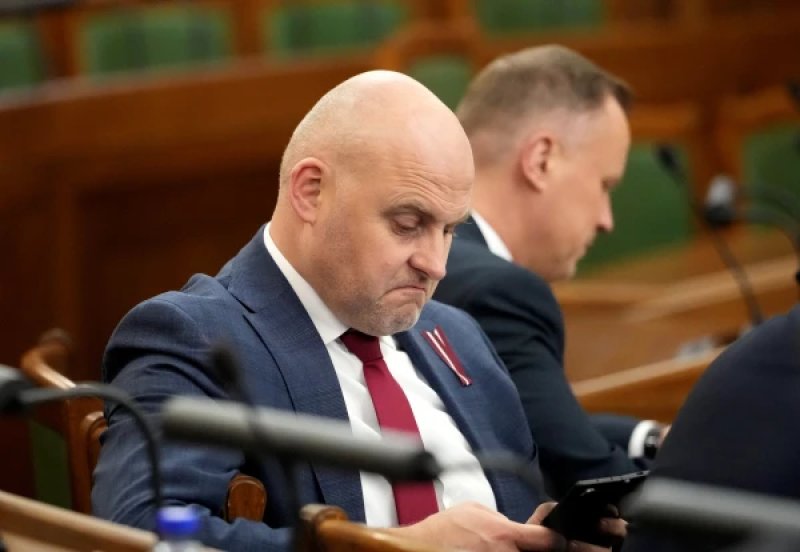
 Foto: BB.LV / Андрис Кулбергс
According to the expert, the new head of government knows how to make an impression and convincingly talk about his plans. However, behind the loud statements, a carefully thought-out strategy for their implementation is not always apparent. ### “There is a feeling that not everything is based on a well-thought-out plan” Rosenvalds noted the difference between the promises outlined in government documents and the real possibilities of their fulfillment. He stated that in the government declaration and other program documents, there are often goals that the country should strive for, but it is not always clear how the authorities intend to achieve them. > “And I have a suspicion that Kulbergs himself does not always know this either. There is a feeling that not everything is based on a well-thought-out plan. It seems that much will still be clarified,” the political scientist said. As an example, he cited the situation with the state budget. Kulbergs' previous government allowed for the possibility of approving the budget for the next year before the end of the current year. However, the new government no longer considers such a scenario realistic. Another example is the idea of creating the Latvian Development Fund. While the project was discussed directly by the Prime Minister, it appeared to be one of the important directions of state policy. But when industry experts joined the discussion, many questions arose for which there are still no clear answers. ### Decisions will be made as circumstances arise According to Rosenvalds, a situational approach to decision-making may characterize Kulbergs' government. This means that many issues will be resolved as specific circumstances arise, and initial plans will be adjusted during the work process. The political scientist believes that one will have to get used to such a management style. At the same time, Kulbergs' own position has changed. If earlier he could focus on presenting attractive political ideas and promises, now he needs to explain to the public the decisions already made, as well as the steps that the government still needs to take. It is here, in the expert's opinion, that the weak points of the Prime Minister's usual communication style may manifest. ### “Kulbergs talks a lot, but his ministers hold him back” Rosenvalds vividly characterized the public behavior of the head of government. > “Kulbergs' communication style is imposing: he rolls his eyes, talks a lot, but his ministers hold him back,” noted the political scientist. However, the expert does not urge making hasty conclusions about the new cabinet's ability to effectively govern the country. He emphasized that the government has just begun its work, so it needs time to settle in and establish interaction among the ministers. According to Rosenvalds, a more objective assessment of the cabinet's prospects can be made after the first 100 days of its activity. It is then that it will become clearer whether the chosen leadership style can ensure the adoption of consistent decisions and the achievement of stated goals. ### The government has a minimal majority in the Saeima Let us remind you that the new cabinet of Andris Kulbergs was approved by the Saeima in November. 57 deputies voted for the government, while 34 parliamentarians voted against it. The ruling coalition was formed by the “United List” (AS) and the National Alliance (NA). Together, these political forces have a minimal parliamentary majority of 51 votes. Thus, the new cabinet will have to not only implement the declared reforms but also ensure the necessary support in parliament. Against this background, the Prime Minister's ability to turn public statements into concrete decisions may become one of the main factors determining the stability of the government.
