

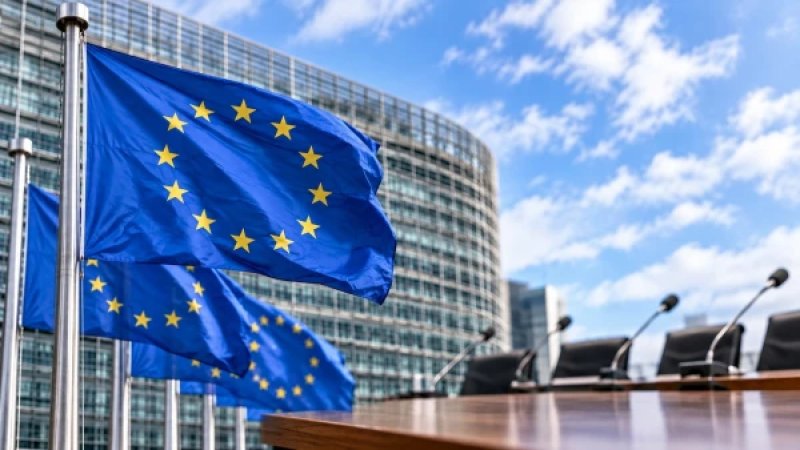
 Foto: BB.LV / Флаг ЕС
According to DPA, the negotiations ended on the evening of Thursday, November 26. Although the EU leaders initially planned to continue discussions on Friday, they abandoned the second day of the meeting. ### "There is still too much work ahead" German Chancellor Friedrich Merz acknowledged that the summit participants are still too far from a final agreement. According to him, significant preparatory work is needed to reach a compromise, so it makes no sense to continue the meeting on Friday. The main point of contention was the distribution of funds in the next seven-year budget of the European Union. The EU needs to find additional money for defense and to enhance the competitiveness of the European economy. At the same time, countries want to maintain traditional agricultural support programs and funding for less developed regions. Combining these tasks has proven to be challenging. ### Wealthy countries demand savings European Council President António Costa convened the summit in hopes of bridging the positions of the countries that contribute the most to the EU's common budget and those dependent on European subsidies. Germany advocates for cuts in spending to avoid a significant increase in its own contributions. Austria, the Netherlands, Denmark, Finland, Sweden, and Belgium share a similar position. Upon arriving in Brussels, Friedrich Merz once again emphasized the need for savings. After the negotiations, he stated that there are still opportunities for further cuts in spending. ### Even €204 billion in savings did not help To bring the agreement closer, António Costa proposed a new compromise budget. It envisions a reduction in spending of about €204 billion compared to the European Commission's initial proposal. As a result, the total volume of the seven-year budget should amount to around €1.78 trillion. However, even after such cuts, spending will remain above the level of the current EU budget for 2021–2027. For Germany and several other countries, the proposed savings were insufficient. Merz indicated that he expects further reductions in spending. Costa himself did not respond to journalists' questions about whether he is ready to propose even more substantial budget cuts. ### Meloni: "We are not ready to pay more and receive less" A completely different position was taken by Italian Prime Minister Giorgia Meloni. Italy is among the countries receiving funds from the EU cohesion funds intended to support less developed regions. Meloni opposed cuts to such funding. "We are not ready to agree to a budget where we have to pay more and receive less," said the Italian Prime Minister. In her assessment, the European Union is still light-years away from reaching an agreement. She emphasized that Italy does not intend to sign the budget just to meet a pre-set deadline. For Rome, the content of the agreements and the fairness of the distribution of funds are more important. ### Macron warned of the risk of a prolonged crisis French President Emmanuel Macron urged European leaders to find a compromise by the end of 2026. In his opinion, prolonging the negotiations could seriously complicate the adoption of the budget. Macron reminded that presidential elections will be held in France in 2027. The first round is scheduled for April 18. Macron, who is serving a second consecutive term, will not be able to run again. The French president warned that if an agreement is not reached by December 31, full negotiations may only resume in the second half of next year. This will increase pressure on the negotiators and create the risk that the multi-year EU budget will not be approved on time. ### Germany supported France, Italy refused to rush Friedrich Merz agreed on the necessity to conclude negotiations as soon as possible. He called for an agreement to be reached at the next EU summit scheduled for December. According to the Chancellor, such an outcome would benefit all of Europe. However, Giorgia Meloni opposed setting strict deadlines. "I am not going to allow deadlines to be dictated to me on this issue," she stated. The Italian Prime Minister emphasized that she needs acceptable terms of agreement, not a fixed deadline. According to her, Italy will sign the budget only when it considers it fair and in line with national interests. ### What will happen next Despite the early conclusion of the meeting, António Costa described the summit as a necessary stage in reconciling conflicting positions. The next round of discussions is set to take place at the EU summit in December. Before that, European leaders need to resolve the main question: how to simultaneously increase funding for new priorities, primarily defense and competitiveness, without depriving states of traditional support and without causing a sharp increase in contributions to the common budget. So far, neither side is ready to make significant concessions, and the fate of the EU budget for 2028–2034 remains uncertain.
